
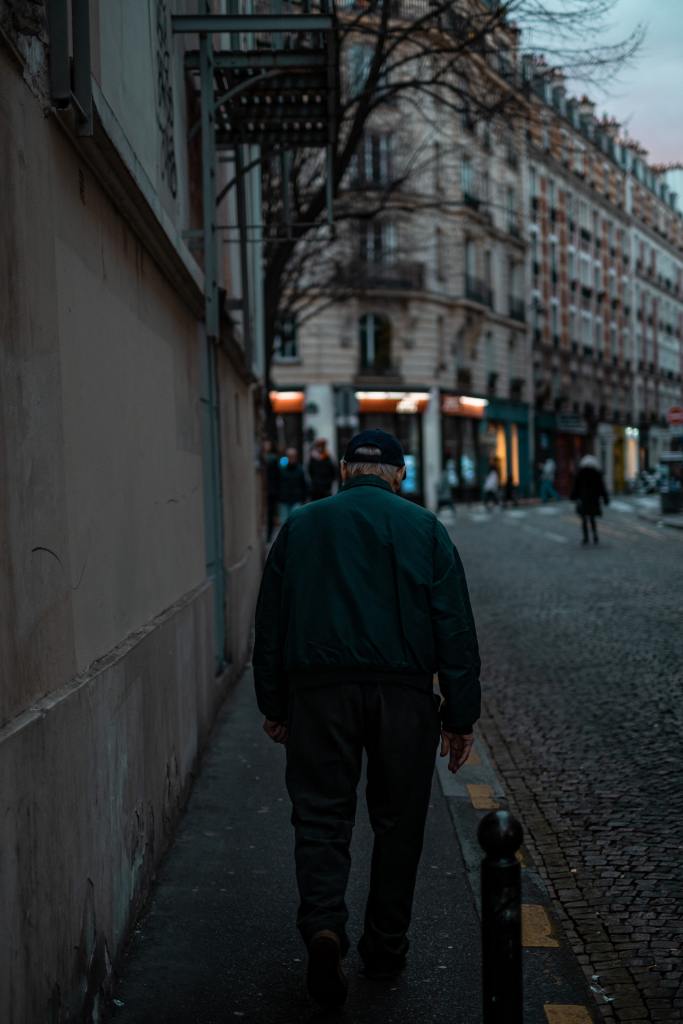
Over the past few months, I have been reflecting on the difference between loneliness and solitude. In English, the two words have slightly different meanings; where loneliness has a more negative connotation, solitude has a more positive one. “Being alone” can be good or bad depending on the feelings and emotions attached to it. We might say, for example, that we enjoy “being along,” but when we say that we are “lonely” it is always value-laden and negative. Solitude, on the other hand, suggests that it is an aloneness that we have sought out, a space that we have carved out for ourselves in which we might devote needed attention on ourselves.
We do not always experience loneliness when we are alone. On the other hand, we may feel very lonely in a crowd. In A Philosophy of Loneliness,[1] the Norwegian philosopher Lars Svendsen, observes:
Loneliness as such cannot be predicted by the number of people that surround an individual, but by whether the social interactions that individual has satisfy his or her desire for connection; that is, by whether they interpret those social interactions as meaningful. Loneliness is a subjective phenomenon.[2]
Svendsen distinguishes between chronic, transient, and situational loneliness and by extension between endogenous and exogenous loneliness.[3] Chronic loneliness describes the situation in which “the subject experiences constant pain on account of having insufficient ties to others.”
Transient loneliness, Svendsen observes, “can overtake us at any moment, whether we are at a crowded party or home alone.”
Situational loneliness is caused by life changes, such as the death of a friend or a family member. The COVID-19 pandemic has forced many people into isolation. This is particularly true for those living in skilled nursing care, who in order to protect themselves, are often isolated not just from their families but from the very people with whom they live in common. Many are left alone in their rooms with little to no contact to family and friends outside because of their current situation.
During the COVOID-19 pandemic we find ourselves in a peculiar form of situational loneliness in which we desire to be with one another person — in school, church, or other social situations — but cannot fulfill the desire for the personal closeness that might mitigate our loneliness because in-person contact in these places is either restricted or forbidden.
Svendson did not have the pecularities of the loneliness brought on by the COVID-19 pandemic in mind when he published this book in 2015. His main contention when he wrote the book is that loneliness, whatever the cause, has more to do with the interpretation of our own internal state, than it does with external factors. Loneliness is experienced as coming from external forces even if that is not truly the case. We may think that loneliness is a fact of our environment and that changing our environment will change our own perceptions of loneliness. Loneliness “is experienced as a lack of satisfying relationships to others” because either we may not have sufficient relationships with other people to satisfy our own expectations or because the relationships we do have do not provide the emotional closeness that we desire — or perhaps both may be the case.
Loneliness feels as if it is being externally imposed on us, but perhaps we have some character traits or personal expectations of others that shape that perception. Do we, for example, feel lonely even in the midst of a large group of friends and family members? Do we expect other people to respond and somehow take care or reduce our own loneliness? “The pain of loneliness,” Svendson argues, “is the pain of insufficient acknowledgment.” In other words, our perceived loneliness may in fact be caused by the expectations we bring to our relationships with others.‘
Instead of expecting others to take away our loneliness, Svendsen maintains, we must acknowledge and take responsibility for our own emotions. “Your emotions are your emotions,” he observes. “They belong to you.”[4] While you can’t choose what or how you feel, you “can try to change the way that you think” about the situations in which you experience loneliness. “You are not lonely because you are alone, you are alone because you are lonely.” It is a loneliness for which you must take responsibility. For despite everything, Svendson says, it is your loneliness.[5]
Loneliness in all its forms will come and go in life. Loss and isolation are a part of living. No matter how many connections you have with others, you may not be satisfied with the quality of these relationships. How then can you find a way to move from loneliness to making more meaningful connections with others? When you acknowledge and take responsibility for your loneliness, that begins to transform your perception of that loneliness. Instead of looking to others to satisfy your longing for connections, you might examine what you expect of others. Rather than viewing your loneliness as something that originates outside yourself, ask yourself what you might do to begin to make more meaningful connections with others?
[1] Lars Svendson, The Philosophy of Loneliness. Kerri Pierce, trans. (London: Reaktion Books, Ltd., 2017).
[2] Svendson, 22-23.
[3] Svendson, 28.
[4] Svendson, 133.
[5] Svendson, 138.
 IN THESE TIMES