
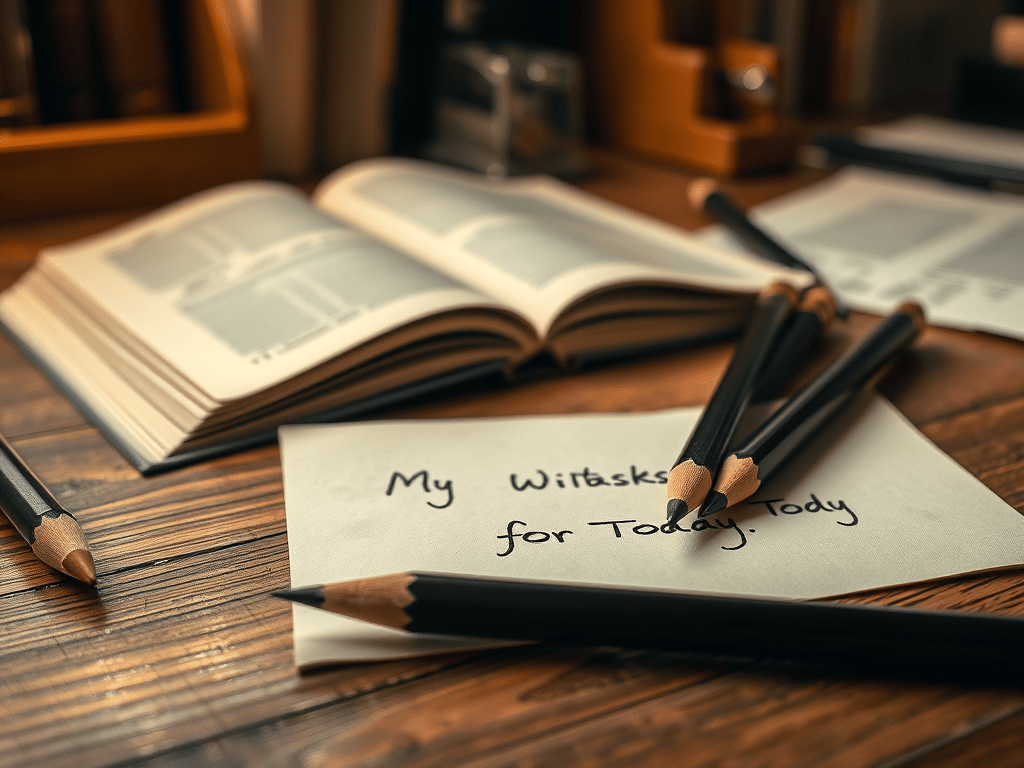
There’s something deeply satisfying about writing with a pencil. The gentle scratch against paper, the distinctive smell of the graphite, and the ability to erase and refine thoughts, make pencils an indispensable tool in my writing.
When I write, I alternate between two loves: the soft scratch of pencils and the expressive flow of my fountain pens. Each brings a unique satisfaction. Having previously explored my passion for fountain pens in my blog post, “Fountain Pens: Writing Magic,” I would like to share why pencils hold an equally special place in my work.
The crown jewel of my wooden pencil collection is undoubtedly the Blackwing Pencil. The pencils come in a variety of colors and density of leads. The longer eraser, held in place by that gleaming brass clasp can be extended as it wears down or be repositioned to the desired angle and length. I maintain a variety of these pencils with differing lead densities, from soft to hard, each serving its own purpose. I like to write with extremely sharp pencils, so I find myself frequently sharpening my wooden pencils. Sometimes, I enjoy the break. It gives me time to stop and think for a moment about what I am writing. Other times, however, the need to sharpen my pencil is an unwanted interruption. When I stop to sharpen the pencil, I might irrevocably lose my chain of thought.
While I like wooden pencils, the newest Japanese mechanical pencils have introduced some groundbreaking innovations:
The Orenz Nero mechanical pencil feeds lead automatically. You don’t have to manually click the pencil, unlike so many other mechanical pencils. This engineering marvel ensures consistent lead length without adjustment, perfect for uninterrupted writing sessions.
The Uni Kurutoga Advance, by contrast, offers a self-rotating lead mechanism that automatically rotates the lead while writing, ensuring even wear and consistently sharp lines. These clever devices maintain a sharp point without me having to think about sharpening the pencil often as I write, as I would with a wooden pencil.
As someone who often works in rare book rooms and archives, pencils aren’t just a preference—they are a necessity. Many institutions ban pens to protect their invaluable collections from permanent marking. Copying material from the books is tedious. So, my choice of pencil varies based on the task. When I find that I am erasing often, I switch to my Blackwing wooden pencils. When I find that I am spending too much time sharpening them, I turn to my Kurutoga Advance mechanical pencil. For completely uninterrupted work, I rely on my Orenz Nero pencil with self-advancing lead.
Both fountain pens and pencils offer distinct forms of creative freedom. My fountain pens are perfect for capturing rapid-fire thoughts and brainstorming.
My premium pencils offer a different kind of freedom. Their smooth graphite provides its own form of flow. It offers the liberty to erase and adjust my ideas as I write. This makes them perfect for evolving ideas—whether sketching concepts or refining drafted thoughts.
In this age of keyboards and touchscreens, I find deep satisfaction in choosing analog writing tools. Each stroke requires intention, and the maintenance rituals—from filling a pen to sharpening a pencil—have become cherished moments. These pauses serve as valuable punctuation marks in my thinking process.
The analog tools of pencils and fountain pens connect me to the physical act of writing. Whether using my Blackwing with its smooth graphite gliding along the paper, or watching my fountain pen dance across the page, each represents a valuable approach to capturing and developing ideas. Mechanical pencils bridge these worlds, offering convenience without sacrificing tactile pleasure. It Is wonderful to embrace the unique character of each writing tool, allowing me to appreciate their distinct qualities and the maintenance demands they require, thereby enhancing the creative process.
 IN THESE TIMES