“COSTLY GRACE”

Today the non-profit. A Faith that Does Justice, published my newest contribution urging Christians (and my secular audience as well) “to speak up and act whenever we see racism and intolerance in the world around us, that is, whenever we see an affront to the dignity of any human person.”

I speak as a retired Episcopal priest and as a Professor of Religion, who has published numerous articles on migration, refugees, and asylum seekers. 

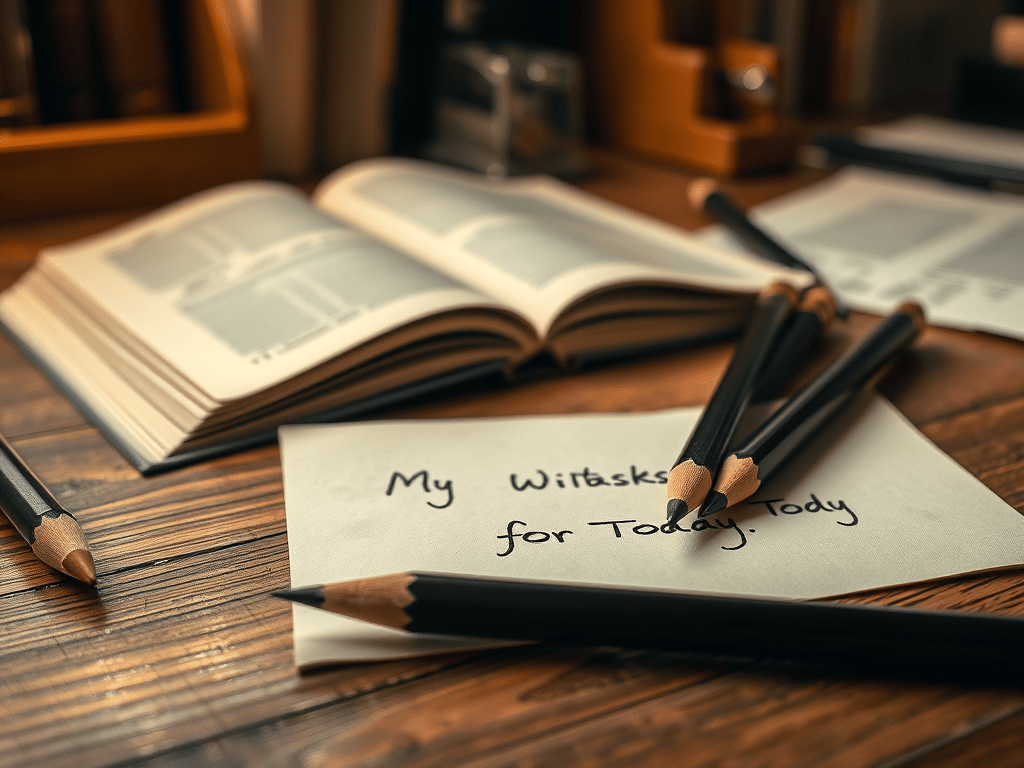
THE JOY OF WRITING WITH PENCILS

There’s something deeply satisfying about writing with a pencil. The gentle scratch against paper, the distinctive smell of the graphite, and the ability to erase and refine thoughts, make pencils an indispensable tool in my writing.

When I write, I alternate between two loves: the soft scratch of pencils and the expressive flow of my fountain pens. Each brings a unique satisfaction. Having previously explored my passion for fountain pens in my blog post, “Fountain Pens: Writing Magic,” I would like to share why pencils hold an equally special place in my work.

The crown jewel of my wooden pencil collection is undoubtedly the Blackwing Pencil. The pencils come in a variety of colors and density of leads. The longer eraser, held in place by that gleaming brass clasp can be extended as it wears down or be repositioned to the desired angle and length. I maintain a variety of these pencils with differing lead densities, from soft to hard, each serving its own purpose. I like to write with extremely sharp pencils, so I find myself frequently sharpening my wooden pencils. Sometimes, I enjoy the break. It gives me time to stop and think for a moment about what I am writing. Other times, however, the need to sharpen my pencil is an unwanted interruption. When I stop to sharpen the pencil, I might irrevocably lose my chain of thought. 

While I like wooden pencils, the newest Japanese mechanical pencils have introduced some groundbreaking innovations:

The Orenz Nero mechanical pencil feeds lead automatically. You don’t have to manually click the pencil, unlike so many other mechanical pencils. This engineering marvel ensures consistent lead length without adjustment, perfect for uninterrupted writing sessions.

The Uni Kurutoga Advance, by contrast, offers a self-rotating lead mechanism that automatically rotates the lead while writing, ensuring even wear and consistently sharp lines. These clever devices maintain a sharp point without me having to think about sharpening the pencil often as I write, as I would with a wooden pencil. 

As someone who often works in rare book rooms and archives, pencils aren’t just a preference—they are a necessity. Many institutions ban pens to protect their invaluable collections from permanent marking. Copying material from the books is tedious. So, my choice of pencil varies based on the task. When I find that I am erasing often, I switch to my Blackwing wooden pencils. When I find that I am spending too much time sharpening them, I turn to my Kurutoga Advance mechanical pencil. For completely uninterrupted work, I rely on my Orenz Nero pencil with self-advancing lead.

Both fountain pens and pencils offer distinct forms of creative freedom. My fountain pens are perfect for capturing rapid-fire thoughts and brainstorming.

My premium pencils offer a different kind of freedom. Their smooth graphite provides its own form of flow. It offers the liberty to erase and adjust my ideas as I write. This makes them perfect for evolving ideas—whether sketching concepts or refining drafted thoughts.

In this age of keyboards and touchscreens, I find deep satisfaction in choosing analog writing tools. Each stroke requires intention, and the maintenance rituals—from filling a pen to sharpening a pencil—have become cherished moments. These pauses serve as valuable punctuation marks in my thinking process.

The analog tools of pencils and fountain pens connect me to the physical act of writing. Whether using my Blackwing with its smooth graphite gliding along the paper, or watching my fountain pen dance across the page, each represents a valuable approach to capturing and developing ideas. Mechanical pencils bridge these worlds, offering convenience without sacrificing tactile pleasure. It Is wonderful to embrace the unique character of each writing tool, allowing me to appreciate their distinct qualities and the maintenance demands they require, thereby enhancing the creative process.

REPOST: “THE LORD LIKES BLUE CHEESE”

The non-profit, A Faith that Does Justice,” has republished another widely read blogpost of mine from this site, “In These Times.” Here is the link to the repost:

REPOST: THE LOAF KEEPER OF ALL CREATION

The non-profit, A Faith that Does Justice,” has republished a widely read blogpost of mine from this site, “In These Times.” Here is the link to the repost:

HEALING, WHOLENESS, AND JUSTICE

This site features my writings on everyday life, but occasionally writing from my work as an Episcopal Priest. I am retired now from that work, but am still active as a blogger and an academic writer.

The non-profit, A Faith that does Justice, has published my third contribution to their column, “The Weekly Word.” This post is the third of four columns that they have chosen to appear on their website. It focuses on the relationship between healing and justice in the teaching and actions of Jesus and on how you, the reader, might enact that justice in the world today.

EMBRACING WINTER MORNINGS: A COFFEE RITUAL

Photo by Benni Fish on Pexels.com

This morning, I woke to the sharp chill of a New Hampshire winter. The thermometer at 6 a.m. read 1°F. Outside, a light layer of snow covered everything, softening the edges of the world in its quiet way. At this hour in Winter, just before sunrise, there is just enough light over the horizon to hint at the day ahead.

I am wrapping my hands around a pottery mug my wife made for me. It’s one of those small, tangible things that brings an out-sized amount of joy. The mug has a beautiful blue glaze. Its handle is wide and perfectly designed for my fingers. As I sipped my coffee, I couldn’t help but admire its warmth in my hands. Making and drinking morning coffee is a ritual that grounds me.

Every morning, I bring my wife coffee in bed. It’s a ritual I’ve honored for years, a small gesture that says more than words ever will. Back when I started doing this, I’d make pour-overs, carefully swirling water in slow circles over the freshly ground beans. These days, I rely on the Dutch Moccamaster, a marvel of practicality and design. It brews coffee with the precision of a pour-over but with less fuss—a reliable companion for early mornings like this.

I think about why I do it. It is the satisfaction of starting the day with intention, a simple act of love as she slowly wakes up. It is another ritual that shapes our days and, by extension, our lives. The act of making coffee, the artistry of a handmade mug, the quiet minutes before the world wakes up—all of these feel like anchors in the chaos of life.

Cold winter mornings in New Hampshire have a way of reminding me of life’s essentials: warmth, love, and the simple joy of sharing. As I hand my wife her morning coffee, I realize that in what I am writing now, I’m trying to capture a moment, not for its grandeur but for its simplicity.

Sometimes, noticing the beauty in the everyday—cold mornings, warm mugs, and small acts of love—is enough.

THE SYNERGY BETWEEN FAITH AND ACTION

The non-profit, A Faith that does Justice, has just published my second contribution to their column, “The Weekly Word.” It focuses on the faith and actions of Abram/Abraham in the book of Genesis.

“ALL SAINTS DAY IS A CALL TO FAITH IN ACTION”

I am happy to announce that my mediation for All Saints Day appeared as “The Weekly Word” for the non-profit organization, A Faith that Does Justice.

A Faith That Does Justice is an interfaith organization that challenges people to experience God by living their faith intentionally in service to others. We do this by showing how unjust societal structures marginalize people and by acting to help those in need.  Our vision is people intentionally living their faith in action.”

FOUNTAIN PENS: WRITING MAGIC

Photo by John Jennings from Unsplash

From the moment I first picked up a fountain pen in elementary school back in the early 1960s, I knew I had found something special. There was a magic in the way the ink flowed from the nib. My journey began with a cheap Schaeffer plastic pen with an ink-filled plastic cartridge. As a kid, I spent most of the time I had one in my hand unscrewing the barrel and looking at the cartridge and then twisting it back on. I did this endlessly. And yes, I frequently got ink all over my fingers. Little did I know that tinkering with a fountain pen would blossom into a lifelong passion, leading me to amass a collection of over one hundred fountain pens and embark on a journey through the world of inks.

While my collection has grown over the decades, I have always been drawn to the practical rather than the purely luxurious. Most of my pens are on the more affordable end of the spectrum – workhorses that I can use daily without fear of losing them. I can count on all my fingers the favorite pens of mine that I have lost while carrying and using them. Some were my favorite pens at the time and their loss still stings. That is not to say I do not appreciate the finer things. I do own a handful of luxury pens, each one a small treasure. But for me, the true luxury lies in the act of writing itself, not necessarily in the price tag of the pen.  Some of my most cherished pens are those I inherited from my grandparents. While my parents had no interest in fountain pens, my grandparents used them daily. These pens, passed down to me, carry not just ink but family history, adding a personal dimension to my collection that goes beyond mere functionality or aesthetics.

My fountain pens have been more than just a hobby – they have been the backbone of my writing life, reliable companions that have seen me through countless rough drafts, papers, sermons, and publications. In the 1970s, when personal computers were still the stuff of science fiction, I relied on a few trusty fountain pens to write the drafts of most of my research papers in college and my first postgraduate program. Even as technology advanced, I found myself returning to the familiar comfort of my fountain pens. I wrote most of my doctoral dissertation drafts with them, feeling the ideas flow from my mind, through the pen, and onto the paper. This tradition continued as I embarked on my academic career, with many of my published papers starting their life as fountain pen scrawls.

There’s something about the physical act of writing with a fountain pen that seems to unlock creativity and clarity of thought. Perhaps it is the tactile connection between hand and paper, or maybe it is the way the ink flows on the paper as I try to write fast enough (and illegibly enough!) to keep up with my thoughts. There’s a smoothness, a consistency that other types of pens simply can’t match. Each fountain pen has its own character, its own way of laying down ink on the page. Each day, I look through my pens to decide what pens I will carry with me that day.  It is always different as my choices depend on how I feel and what I want to pen to do. 

Recently, I have also found myself drawn into the world of ink collecting. While there’s a rainbow of colors available, I find myself gravitating towards the blues. From purple blue to deep navy to bright cerulean, each shade offers its own mood and personality. I now have around ten different jars of ink in various shades of blue. There is something endlessly fascinating about the subtle variations between different blue inks. Over the past few months, I have begun experimenting with orange, olive, red, and several other interesting shades. 

You might wonder why anyone should care about one person’s obsession with fountain pens. In our digital age, isn’t handwriting becoming obsolete?

I would argue that it is precisely because of our increasingly digital lives that fountain pens and handwriting hold such appeal. In a world of email, instant messages, and content written on a computer, there’s something profoundly human about putting pen to paper. It is a tactile, personal experience that connects us to centuries of written tradition. In our digital age the fountain pen stands as a bridge between past and present. It is not just a writing instrument, but a testament to craftsmanship, a celebration of individuality, and a rebellion against the ephemeral nature of digital text. Each stroke of a fountain pen is a small act of creation, leaving a tangible mark on the world that pixels can never quite replicate.

So, whether you’re a fellow enthusiast, a curious newcomer, or someone who’s never given fountain pens a second thought, I invite you to consider the humble fountain pen not just as a writing tool, but as a more tactile, and more personal way of expressing yourself. You might just find, as I did all those years ago, that there is magic flowing from that nib.

THE LEGACY OF MEMORY

As I have gotten older, I am realizing more and more that my own grandparents did not live much past my current age. I find myself wondering what their life was like at this same stage in my life. I also find myself wishing that I had asked them more questions about their lives.  

My father died at the age of 58 as did his father. My maternal grandmother died in her early 80’s, but my other two grandparents died in their early seventies, an age I am rapidly approaching.   

My grandparents all lived through two World Wars and  the Great Depression. As I was still a teenager when two of them died and a young married person when my maternal grandmother died, I did not think to ask them much about their lives. Now, I wish I had been more inquisitive and willing to listen to them. 

As a teenager, I was an avid fan of military history from the Napoleonic Wars through WWII. I assembled and painted numerous plastic models of airplanes, warships, and tanks of WWI and WWII. I even painted some 2000 miniature plastic figures from the Napoleonic Wars, each one with an authentic uniform. I perhaps was one of the few youth who ordered books in French, with pictures of Napoleonic Uniforms and I had accounts with English booksellers for the same purposes. I had quite a collection of military figures, but when I returned home from college one year, I found that my parents had cleared out my bedroom to make it a more generic guest room and they threw them all out along with my models. 

Bob, my mother’s brother, a private in the 29th Infantry Division of the United States Army, landed on Omaha Beach as part of the D Day Landings. He was separated for weeks from his unit, but eventually regrouped. Shortly after reuniting with his unit, he was wounded in the Battle of Saint-Lô, sometime between July 7 and 19, 1944. He was  hit in the back of his right arm, most likely by shrapnel from explosives mistakenly dropped by American planes from behind the front lines. As an enthusiast of books and movies on WWII, I begged my uncle to tell me more about what he experienced overseas in combat, but my family always steered me away from that discussion with him. If I asked him alone, I got little out of him. The only story I ever heard from him was that as they approached the shore the landing craft that held him and his fellow combatants hit a German mine. Most of the soldiers drowned with 50 pound packs still on their backs, but my uncle, an excellent swimmer, was able to drop his pack and swim to shore, In the confusion, it took him three weeks to be reunited with his unit. He never really recovered from his ordeal, living most of the remainder of his life with his parents before dying at the age of 67 at the Soldier’s Home in Chelsea, Massachusetts. I remember that he had an abiding dislike of the nasal sound of the French language. That is what he remembered hearing, but not understanding, after he was wounded and transferred from hospital to hospital in the vain attempt to restore his damaged arm. Apart from that I know little else about his wartime experience.   

Over the years, my uncle became more and more of a recluse, although to the family, he talked endlessly about cars and every new model that appeared. When he returned from the war, he felt that, because of his disability, he no longer was good enough for his girlfriend, and that he would only be holding her back from a happy life. Without telling her anything directly, his apparent disinterest in her drove her away gradually. That’s all I know. I realize now that he was most likely suffering from depression and some sort of PTSD, which was not understood well at the time. The term “shell shocked,” which emerged from the experience of troops from WWI, came the closest to describing his experience. His parents were endlessly frustrated by what they thought was my uncle’s lack of motivation and chalked it up to laziness. As a result, relations between my uncle and my grandfather were fraught. I was aware of this at the time, in the way a child knows that something is not quite right, but I loved to be with my uncle and looked up to him in a way that even now I can’t say exactly why. 

After the war, Bob found it difficult to find a job. Before the war he had studied business, but the fact that, with his wounded right arm he was not able to shake hands, meant that few wanted to hire him. He ended up packing and shipping boxes in a factory that produced box toes for the shoe industry in Haverhill, Massachusetts. 

Uncle Bob was my only uncle. My father was an only child and my mother only had one brother.  o because Bob never married and had children, I never had an aunt or any first cousins. He was it. I wrote what I did here, so that my uncle’s story, however incomplete, is not entirely lost forever.

What remains of a person after they have died?  I have none of my uncle’s personal effects. For a time we had his bed frame, but that is no longer with us. My mother framed his purple heart and other medals from the war and hung them on her wall.  So what remains, other than the memories of those who, like me, knew him and still remember him? There are fewer and fewer people alive who knew Bob and knew some of his story. After all, he, like my father, was born about 100 years ago. What will happen when we too die and those memories are lost forever?  

I began thinking about some of the events in my own life that I think were important and how I would like my children and grandchildren to know about them when I am no longer alive. I think it is time to start writing some of that down, because they, like me at their age, will not think to ask what later in their lives they might wish to know. My hope is that my memories will mix with their memories of me and perhaps that bundle will enrich their lives as well.

What would you want subsequent generations to remember most about you?