
A Faith that Does Justice has published another contribution of mine as the “Weekly Word.” The article poses the question, why do the people of God often fail to appreciate, or even notice, God’s many blessings and be thankful for them?

CRAIG A. PHILLIPS, PH.D.
A Faith that Does Justice has published another contribution of mine as the “Weekly Word.” The article poses the question, why do the people of God often fail to appreciate, or even notice, God’s many blessings and be thankful for them?
The non-profit, A Faith that Does Justice,” has republished a widely read blogpost of mine from this site, “In These Times.” Here is the link to the repost:
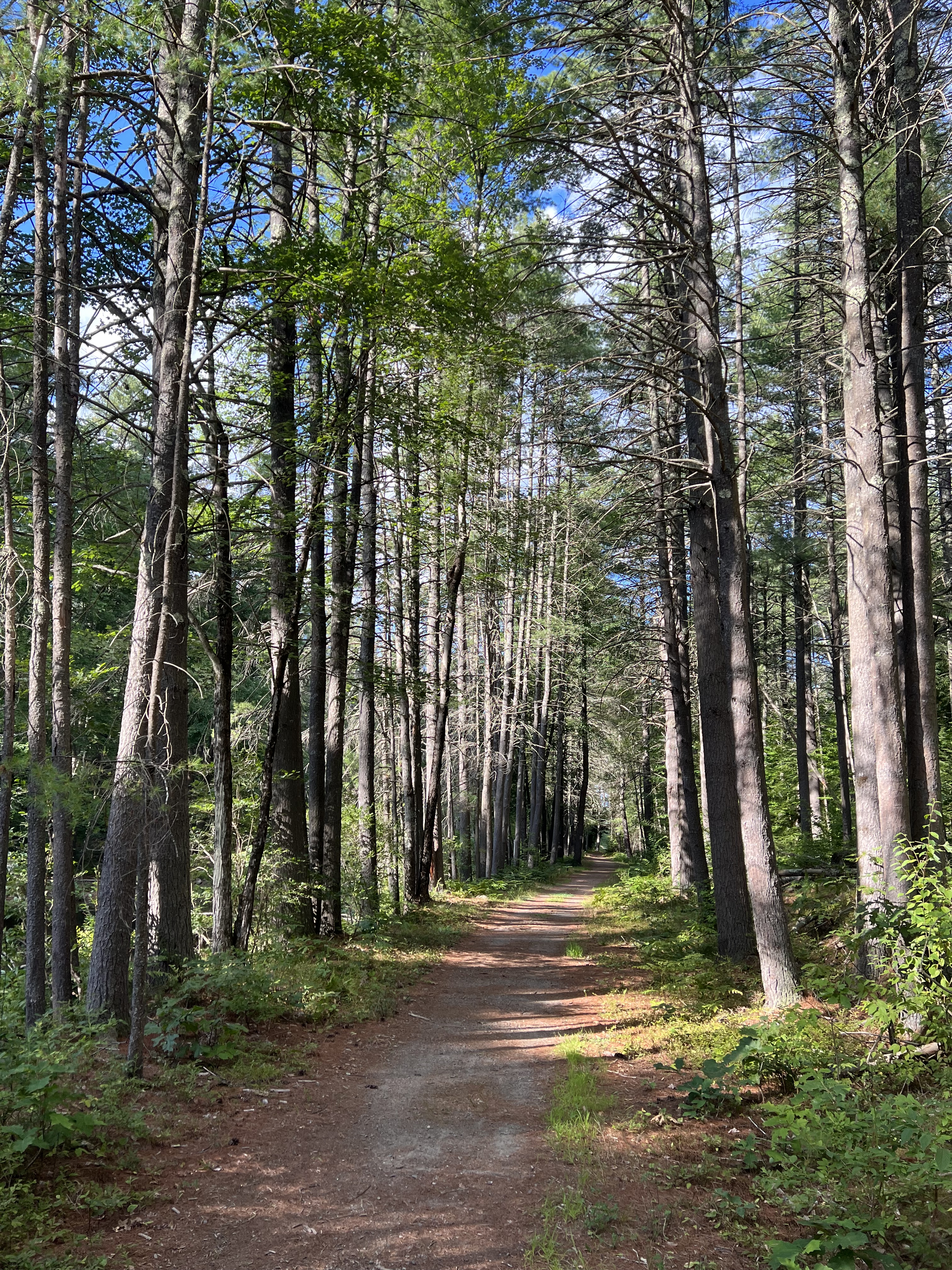
Photo by Craig A. Phillips
I’m fully retired again. In August, I agreed to fill in for two persons who were going on sabbatical, one a parish priest and the other a college professor. As a result, the rhythms of life in retirement changed for both me and my wife. I began working on Sunday morning preaching and celebrating at a parish about 40 miles from home and teaching two classes of “Biblical Theology” from Monday to Thursday at St. Anselm College in Manchester, NH, about 20 miles from home. Both of my classes began at 4:00 PM or after, so I spent most of the day prior to class preparing for the next class, grading, and corresponding with students and faculty. All of this had an impact on my wife as well, as she was around while I worked and stressed on my preparations. Our ability to do things together during the day and our ability to travel, visit our children and grandchildren, and other family members was limited by my new work schedule.
Throughout these somewhat hectic four months, I asked myself, “have I failed retirement?” The answer for me was “no.” After all, I had not returned to full time work. Both positions were part-time. But as anyone who has ever worked part-time knows, part-time often feels just the same as full-time. There was never any question that this was not work. It certainly was. At the same time, however, retirement gave me the opportunity to do the things I love. Isn’t retirement a time in which one has the chance to do the things you want to do, but do not have to do?
In a previous blogpost, “Getting the Hang of Retirement,” I wrote, “More than one of my retired friends has told me that it took them the better part of three years to get used to it. So, I am just a beginner. … In three years, I’ll let you know if I’ve finally gotten the hang of it.”
It has now been exactly two and a half years since I retired from full-time work. According to this self-imposed schedule, I only have six months left to figure it out. I can honestly say that this is a process, much as preparing for retirement is. It changes from day to day, week to week, and month to month. In six months I doubt I will fully get the hang of it — but I’m on my way. This is a time of life in which there are seemingly endless possibilities and only limited time in which to choose from them.
For now, we have begun to travel again to see family members we have not seen in a while. We have two to three trips planned for this year. I also am re-engaging with my academic writing and research in rare books and maps from the early 17th century with an end to publishing a journal article or perhaps a scholarly monograph. I am used to using the pressure of a deadline to focus my writing, but I am trying not to make this another task that feels like work, so I must figure out how to have fun doing it, without the feeling of compulsion that I must write so many pages a week. I often feel that if I am not working on my research and writing that I have somehow failed. Much as with retirement in general, it will take time to figure out how to engage in something that is fun for me to do, without feeling that it is one more task that must be accomplished as it would were it related to my employment.
There are only so many years when we will be able to travel and so many years left to write what I hope to write. How will I make the best use of that time? That question is important for all of us, no matter our stage of life. How will we best use the time that is given to us? That is a question to ponder again and again. Asking this question in retirement is different only because it comes after years of working, when we did many things that we did not really enjoy doing, but nonetheless had to do. Now we who are retired must answer that question anew in light of our circumstances.
I know that I must be retired again when I can’t remember what day it is, and everyday seems to feel like Saturday. Now there is time to do the things I love to do. Let’s go and see what happens!

Snow now blankets the ground in New Hampshire. The maple and birch trees are bare of leaves but full of snow. The air is crisp and cold. When it’s snowing, the air has a kind of sound that is difficult to describe. It’s got a texture to it as if someone were brushing the air with a stiff brush. Other sounds seem to recede into the background, and I’m left to listen to the snowflakes as they fall. It’s amazing how peaceful and tranquil it can be.
It has snowed twice this past week, accumulating in total around ten inches of snow. Snow banks along the road are now two to three feet high. I have been busy with my self-pushing electric snowblower, clearing our driveway, which runs up hill from the street towards our house.
More snow is expected today, so I’ll be busy. I don’t mind the work. In fact, I enjoy it. Some people curse the snow and can’t wait to be rid of it. Not me, I love it.
Now that I’m retired, I don’t have to worry about getting to work on time. Even so, people in New Hampshire are used to dealing with snow and for the most part are nonchalant about it. What I like most about snow on the ground and in the trees, apart from its beauty, is its contrast with the heat of the summer months. The change of the seasons, each with its own characteristics, adds variation in the passage of the year such that each day does not pass with relentless uniformity. Each day has its special treasures for us to discover. Weather comes and goes, and if we can move with the flow, we can enjoy the riches that each day has to offer.
I’m getting ready for a walk outside later today and I’m looking forward to hearing the bristling sound of snow falling, the sound of peace and calm. Then I’ll be back going up and down the driveway with my snowblower.
“OCTOBER”
Robert Frost — 1874-1963
O hushed October morning mild,
Thy leaves have ripened to the fall;
To-morrow’s wind, if it be wild,
Should waste them all.
The crows above the forest call;
To-morrow they may form and go.
O hushed October morning mild,
Begin the hours of this day slow,
Make the day seem to us less brief.
Hearts not averse to being beguiled,
Beguile us in the way you know;
Release one leaf at break of day;
At noon release another leaf;
One from our trees, one far away;
Retard the sun with gentle mist;
Enchant the land with amethyst.
Slow, slow!
For the grapes’ sake, if they were all,
Whose leaves already are burnt with frost,
Whose clustered fruit must else be lost—
For the grapes’ sake along the wall.
In mid-September, my wife and I moved to New Hampshire following my retirement as Rector of St. Peter’s Episcopal Church in Arlington, Virginia. We arrived shortly before the foliage began to change and the leaves began to fall.
As I watched the changing October foliage all around me, I was reminded of the poem “October” by Robert Frost. I thought of it for two reasons. First, the poem expresses a desire for the slowing of time to allow time for the appreciation of the present season and present moment. Winter in the poem is a metaphor for death and so the poet in the season when the days get shorter and shorter asks for the retarding of time and a delay in the onset of winter. This delay is also good for the grapes who will have more time to ripen on the vine before it is destroyed by frost.
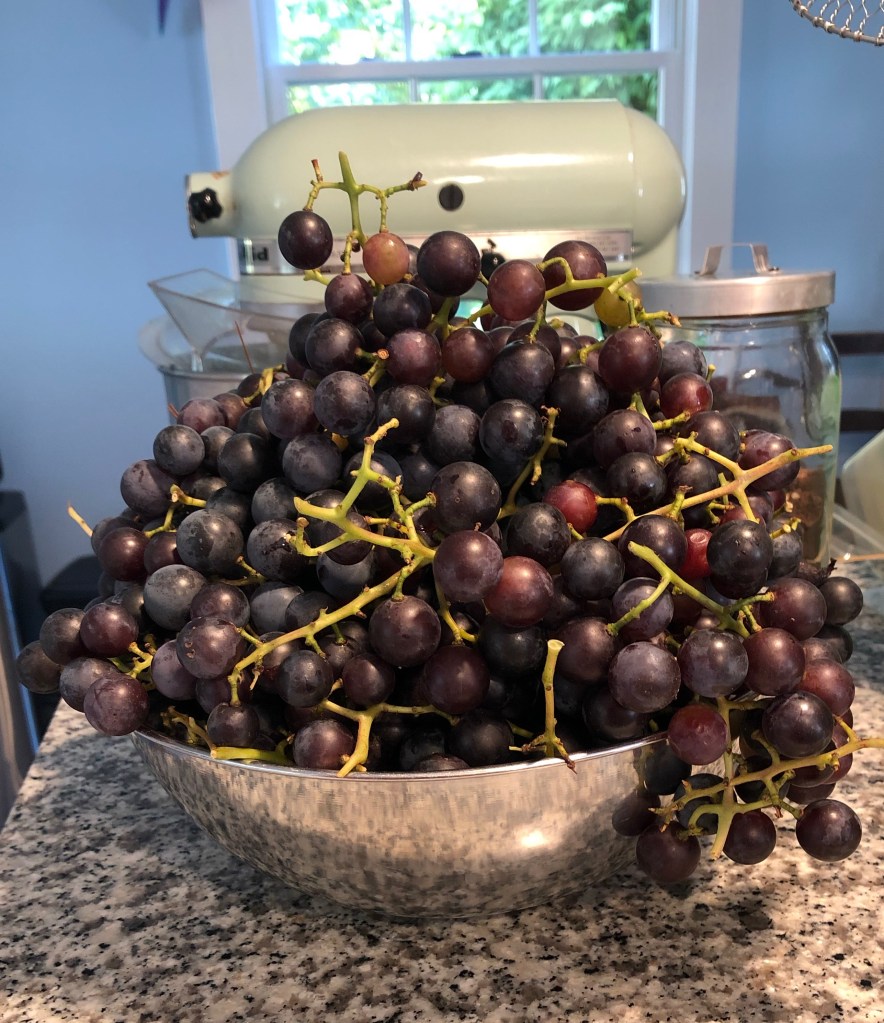
The window behind our kitchen sink looks out to an old wooden fence on which grows a vine of Concord grapes. From that one vine, I have harvested 10 pounds of grapes. With the first five-pound harvest, we made delicious grape jelly. The second five-pound harvest now is in the freezer for later cooking and canning. At the second harvest, the vine was beginning to wither and brown. “For the grape’s sake,” I left them on the vine for as long as I could so that they would ripen as much as possible. At the end of October, the vine is now spent.
In the middle of the poem, the poet asks that October, “Enchant the land with amethyst.” In Greek amethyst means “not intoxicated.” The Greek myth describing the origin of the amethyst stone relates to the Greek god Dionysus (Roman, Bacchus), the god of wine and intoxication, who fell in love with the beautiful maiden Amethyst, who as her name suggests was “not intoxicated.” She rebuffed Dionysius driving him in his rage to seek to kill her. To protect Amethyst, the goddess, Artemis, changed the maiden into a clear quartz stone. As Dionysius lamented her new state, he spilled wine over her turning her into a beautiful purple stone. Grapes ripening on the vine are transformed in the fall from green berries into a wonderful purple, as rich as any amethyst.
Second, the poem speaks to me in my current situation. I have worked for over 40 years and now have decided to retire from full-time work. I don’t want to think that I am in the fall of my life with winter coming soon on its heels. I would like to think that I am in the spring of my life with new possibilities, new hopes, and new dreams to fulfill. Of course, I am not getting any younger, so I too long that the time be slowed and that in each of my remaining days I may be beguiled and filled with wonder at the beauty of life around me. Like grapes on the vine, I want to ripen and flourish before my time comes to an end. And on top of that, with its bright foliage, fall in New Hampshire is stunning — even enchanting.
From 1900 to 1911 Robert Frost lived on a Farm in Derry, New Hampshire in two-story, clapboard house on an eighteen-acre farm that had been built in 1884. Frost’s farm (now a State Park) is less than 20 miles from our new home in New Hampshire as the crow flies. Frost moved to England in 1912 only to return to the states at the end of 1914. The poem, “October” was first published in England in 1913 in the book, A Boy’s Will. I feel certain from reading it —but I don’t’ know for sure — that he must have written it while he was living in New Hampshire.
It is my hope that as you read this, in whatever time of life you find yourself, that you will take time to let your heart be beguiled by the beauty of the sunlight, the change of the seasons, and the beauty of creation all around you.

Photo by Bundo Kim on Unsplash
Because things do not always go according to our plans or our desires, disappointment and hope always go hand in hand. We may discover the truth of that observation when we apply for a job or for admission into a program, organization, or school. You might think, for example, that you and your prospective employer or program are a perfect match, but despite your earnest efforts and self-confidence, you, for reasons often beyond your control, may not be chosen. It is always easy to get discouraged. That’s why, after such a disappointment, writing the next letter of application or making the next phone call is sometimes so hard to do.
I know how it feels to be rejected. A tall metal file cabinet in my home office contains a folder of hundreds of rejection letters that I received from 1988-1993 in reply to my application for university teaching positions. I was not alone. It seemed to be the norm then, both for me and for my classmates that one out of two hundred letters resulted in a full-time academic teaching position. Many persons I knew, despite their hard work, could only find adjunct teaching positions with low pay, no benefits, and no job security. I was extremely lucky to land the position I did at Temple University in a time of hefty budget cuts and hiring freezes.
In her senior year of college, my youngest sister and her suitemates devised the best strategy I know for dealing with the frequent disappointment that comes with applying for a job. Every rejection letter that she and her friends received from prospective employers was posted on the walls of their suite. By early May their walls were completely covered with rejection letters pasted side by side and end to end. This communal sharing of their rejection letters made it obvious to each of them that the rejections could not be taken personally, that is, each response was not a rejection of them as a person. They each knew that they had specific talents and skills; they only needed to find an employer who would appreciate those abilities.
Despair and hope go hand in hand. To live our lives fully we have to continue to hope in the face of despair. In Advent, we are often reminded of our “eager longing” and hope in the present for the future redemption of the whole creation (Romans 8:19 ff.).
The hope of the Hebrew people for a Messiah was borne and nurtured through centuries of disappointments, military disasters, and cataclysms. Their hope in the face of many reversals and disappointments was unabated. This hope was sustained, just as my sister had learned in her senior year in college, because together her suitemates were able to support one another in bad times just as they did in good times. The hope that they nurtured together empowered them to live under the promise that something better was yet to come.
The season of Advent this year is unlike any other in my lifetime. With the COVID-19 pandemic, we are unable to safely meet together for in-person worship and fellowship, where we would, if only we could, support one another in person. We have found other unexpected ways to stay connected with Zoom and YouTube, and other electronic resources, that while they can never replace person to person contact, they have allowed us to widen the sphere of our connections, allowing people who might not otherwise be able to join us whether because of health or distance from us to do so. Even in the midst of our present despair, loneliness, and lack of meaningful personal connections, we remain hopeful that better days will soon be at hand.
Over the past few months, I have been reflecting on the difference between loneliness and solitude. In English, the two words have slightly different meanings; where loneliness has a more negative connotation, solitude has a more positive one. “Being alone” can be good or bad depending on the feelings and emotions attached to it. We might say, for example, that we enjoy “being along,” but when we say that we are “lonely” it is always value-laden and negative. Solitude, on the other hand, suggests that it is an aloneness that we have sought out, a space that we have carved out for ourselves in which we might devote needed attention on ourselves.
We do not always experience loneliness when we are alone. On the other hand, we may feel very lonely in a crowd. In A Philosophy of Loneliness,[1] the Norwegian philosopher Lars Svendsen, observes:
Loneliness as such cannot be predicted by the number of people that surround an individual, but by whether the social interactions that individual has satisfy his or her desire for connection; that is, by whether they interpret those social interactions as meaningful. Loneliness is a subjective phenomenon.[2]
Svendsen distinguishes between chronic, transient, and situational loneliness and by extension between endogenous and exogenous loneliness.[3] Chronic loneliness describes the situation in which “the subject experiences constant pain on account of having insufficient ties to others.”
Transient loneliness, Svendsen observes, “can overtake us at any moment, whether we are at a crowded party or home alone.”
Situational loneliness is caused by life changes, such as the death of a friend or a family member. The COVID-19 pandemic has forced many people into isolation. This is particularly true for those living in skilled nursing care, who in order to protect themselves, are often isolated not just from their families but from the very people with whom they live in common. Many are left alone in their rooms with little to no contact to family and friends outside because of their current situation.
During the COVOID-19 pandemic we find ourselves in a peculiar form of situational loneliness in which we desire to be with one another person — in school, church, or other social situations — but cannot fulfill the desire for the personal closeness that might mitigate our loneliness because in-person contact in these places is either restricted or forbidden.
Svendson did not have the pecularities of the loneliness brought on by the COVID-19 pandemic in mind when he published this book in 2015. His main contention when he wrote the book is that loneliness, whatever the cause, has more to do with the interpretation of our own internal state, than it does with external factors. Loneliness is experienced as coming from external forces even if that is not truly the case. We may think that loneliness is a fact of our environment and that changing our environment will change our own perceptions of loneliness. Loneliness “is experienced as a lack of satisfying relationships to others” because either we may not have sufficient relationships with other people to satisfy our own expectations or because the relationships we do have do not provide the emotional closeness that we desire — or perhaps both may be the case.
Loneliness feels as if it is being externally imposed on us, but perhaps we have some character traits or personal expectations of others that shape that perception. Do we, for example, feel lonely even in the midst of a large group of friends and family members? Do we expect other people to respond and somehow take care or reduce our own loneliness? “The pain of loneliness,” Svendson argues, “is the pain of insufficient acknowledgment.” In other words, our perceived loneliness may in fact be caused by the expectations we bring to our relationships with others.‘
Instead of expecting others to take away our loneliness, Svendsen maintains, we must acknowledge and take responsibility for our own emotions. “Your emotions are your emotions,” he observes. “They belong to you.”[4] While you can’t choose what or how you feel, you “can try to change the way that you think” about the situations in which you experience loneliness. “You are not lonely because you are alone, you are alone because you are lonely.” It is a loneliness for which you must take responsibility. For despite everything, Svendson says, it is your loneliness.[5]
Loneliness in all its forms will come and go in life. Loss and isolation are a part of living. No matter how many connections you have with others, you may not be satisfied with the quality of these relationships. How then can you find a way to move from loneliness to making more meaningful connections with others? When you acknowledge and take responsibility for your loneliness, that begins to transform your perception of that loneliness. Instead of looking to others to satisfy your longing for connections, you might examine what you expect of others. Rather than viewing your loneliness as something that originates outside yourself, ask yourself what you might do to begin to make more meaningful connections with others?
[1] Lars Svendson, The Philosophy of Loneliness. Kerri Pierce, trans. (London: Reaktion Books, Ltd., 2017).
[2] Svendson, 22-23.
[3] Svendson, 28.
[4] Svendson, 133.
[5] Svendson, 138.
Over the past few months, as a result of the ongoing COVID-19 pandemic, I have been working mostly from home. During this time, I have thought a lot about what Jesus says in the 6th chapter of the Gospel of Matthew in which he tells his followers not to worry about what they will eat or drink or wear. “Strive, first for the kingdom of God and his righteousness, and all these things will be given to you as well.” Then he concludes: “So do not worry about tomorrow, for tomorrow will bring worries of its own. Today’s trouble is enough for today” (Matt. 6:31–34 NRSV).
We are living in a time of great anxiety. How can we live without worry? Is it possible? And if it is, how would we go about putting it into practice? As I reflected on these questions, I was reminded of something that Thomas Merton had discovered on this topic in the writings of the 6th century Syriac bishop and monk Philoxenos of Mabbug. I will come to that in a minute, but first, let me say something about Merton and Philoxenos.
The American Trappist (Cistercian) monk, writer, theologian, poet, and mystic Thomas Merton (January 31, 1915 – December 10, 1968) was among the greatest Christian spiritual writers in the 20th century. The 1948 publication of The Seven Story Mountain, Merton’s autobiographical account of his conversion to Roman Catholicism and his decision to become a Trappist monk, was propelled by critical acclaim to the best-seller lists of the day and led to an enormous increase in the number of people seeking monastic vocations.
During my seminary training, I studied ancient Syriac, a dialect of ancient Aramaic that bears a close resemblance to the language that Jesus spoke. There were vast numbers of Syriac-speaking Christians in the early centuries of the church, but many people in the West are entirely ignorant of the great wealth of theological and spiritual treasures that were written down in Syriac language along with the central importance of ancient Syriac texts and translations for the study of the text of the Holy Scriptures.
Because of my interest in Syriac literature and language, I became interested in what Merton had to say about Philoxenos of Mabbug (Aksenāyâ Mabûḡāyâ, ܐܟܣܢܝܐ ܡܒܘܓܝܐ (ca. 440-523 A.D.). His monastic name, ’Aksenāyā means “the stranger,” or, in other words, a person who was a lover of hospitality. In Greek that was translated as Philoxenos (a friend or lover of strangers,” or “the hospitable one.”)
Philoxenos was a monk and bishop in the Syriac Jacobite Church that separated from the Churches of Rome and Constantinople following the Council of Chalcedon in 451 A.D. That council declared that the incarnate Word, Jesus Christ, had two natures, one human and the other divine and that those who held otherwise were heretics and were no longer welcome in the church. The Syriac Jacobite Church, formed in reaction to the Council of Chalcedon, was officially miaphysite, that is, they insisted that after the incarnation the human and divine natures were merged in such a way that the incarnate Word had only one nature (Gk. mia = one and Gk. physis = nature). This might seem to be of minor theological importance today, but at the time and for the centuries that followed, it was a church-dividing issue.
An important source for Merton’s wisdom is found in the conferences that Merton, known as Fr. Louis within the monastery, held with the novices at the Abbey of Our Lady of Gethsemani, near Bardstown, Kentucky. Merton was the novice master and as such was responsible for the academic formation of monks in training. While recordings exist of many of these conferences (or what we might also call classes), most of them have not been published.[1]
What drew Merton to Philoxenos was their shared monastic vocations. Despite the fact that Philoxenos was from a separated church, the deep wisdom of his reflections on how to live simply as a monastic ineluctably drew Merton to his writings. This wisdom, as Merton demonstrates in his conferences, is just as valuable to those living out monastic vocations as it is to those of us who are not.
The genre Philoxenos employed in his Discourses was the mēmrā (Syriac plural, mēmrē). The genre can best be described as metrical poetry in the form of a homily addressed to a monastic audience. The thirteen Discourses of Philoxenos begin with an introductory mēmrā followed by pairs of mēmrē, each pair centered on the same theme but developed in different ways. It is not immediately clear why two separate mēmrē were written on the same theme. Sometimes the first of the two mēmrē takes a moralistic tone while the second takes a more mystical tone. Or, perhaps the second is a later reworking of the first. There is no consensus on this.
Mēmrē 4 and 5 both focus on the topic of “simplicity.” After a brief analysis of a passage from Philoxenos that Merton identifies for discussion, I will look to see what Merton does with this topic in the conferences with his own monastic students.
In Mēmrā 4, “On Simplicity,” Philoxenos discusses the simplicity of Jacob who was unfairly deceived more than once by Laban his father in law. In spite of this, Philoxenos writes, “The purity of Jacob was not afraid and his simplicity was not shaken, and his innocence did not become inflated.” As long as Jacob was attending to his own concerns, God was concerned for him about the other external things that happened to Jacob. Jacob, thus, “is an example of enlightened instruction to all who wish to labor with the Lord: one should not let his thoughts cease from reflection on God nor occupy them with devising schemes by which to harm his enemies.”[2] From the example of Jacob, Philoxenos turns to the monastic audience and exhorts them with the following words.
But you, O disciple, remain in the purity of your mind. It is the Lord’s to know how to guide your life, and which things are beneficial for you that he should do for you. Have you heard about others that are preparing to do harm to you; and others that are lying in ambush to take your life; … and others that reproach your glory and find fault with your way of life; and others that dig in order to throw you on the earth from the height on which you are standing; … or others that speak against and revile you, and hurl mocking abuses on you…? But you, in all of these things, remain in your simplicity and do not turn your back from where you have been watching, and do not cease from your secret conversation with God.[3]
Philoxenos continues:
Do not let the coercion of these things outside of you defeat the coercion of the hidden anchor on which your life is suspended, but hold on to Christ with the hope that is not found false, according to the promise of Paul to us, “Let us hold on to the hope that was promised to us, which is to us like an anchor tied onto our soul” so that you may not be moved.[4]
It is quite interesting to see what Merton makes of this passage. As he interprets it to his own monastic audience, Merton seems to have Jesus’ admonition not to worry about what is going to happen to us in the future in the back of his mind, even though neither Merton nor Philoxenos mention it explicitly. “So do not worry about tomorrow, for tomorrow will bring worries of its own. Today’s trouble is enough for today” (Matt. 6:34).
In his monastic conferences, Merton frequently relates what Philoxenos has to say with examples from Zen Buddhist themes and texts. It is the juxtaposition of the texts of Philoxenos with the Holy Scriptures and Zen Buddhist ideas that makes Merton’s idiosyncratic interpretation so remarkable.[5]
After talking about what Philoxenos wrote on the topic of simplicity in much more detail than have outlined here, Merton makes the following, somewhat colloquial, observations:
Anxiety about yourself. What is going to happen to me? Now this, I would say, is extremely important. This is the big thought. And this is the thought that we as monks really need to learn how to handle. This is the thought. What is going to become of poor me? One year from now, ten years from now, where am I going to be? What is going to happen? How’s it going to be? So I’m going to croak, but how, when, where? It doesn’t matter. What we have to do is attain this purity of spirit and let God take care of it. What is going to happen to me is of no importance. Why? Not because in itself it is of no importance. But it is useless for me to worry about it because it is already taken care of. So this is purity of spirit in this particular context. And this is simplicity.[6]
As Merton continues his reflections about the anxiety that each of us faces in our own ways, he relates it first to the experience of his monastic colleagues, who even in their partially cloistered existence can never be sure what tomorrow will bring. As Merton talks, he gradually brings his monastic audience back to what Philoxenos says about hope and why when we put our ultimate “hope” in God we find not only simplicity of life but rest from the overwhelming anxiety that so often clouds our ability to see that hope. Merton says:
[You] don’t stand back and judge what God is making out of your life. This is absolutely essential. What we are constantly doing [is] constantly looking at our lives: where are we going, how is it going, how are we going to get there, how am I going to get around the next corner and what happens at 5 pm or 5:26 and what’s going to happen at 5:27? How am I going to get this done? What’s going to happen if he says this, what do I say? And if Reverend Father makes the foundation in Norway, then what? This is what we have to learn not to do. It’s extremely important for the contemplative life. And this is the real contemplative life to stop doing this! But it’s extremely hard. It’s very difficult indeed. And so what we have all got in our heads is a whole lot of gimmicks about ‘how to make it’ and ‘how can I handle this’ and all these eventualities and so forth. So there’s a great deal of anxiety. And the answer is hope. We have got to have real hope in God, because when we’re thinking about ourselves and figuring out about ourselves we’re not hoping—we’re figuring! To figure is not to hope! We have to put all the important stuff in God’s hands.[7]
At this point, Merton makes a turn in his interpretation of Philoxenos that seems to interweave what Merton’s reading of Buddhist texts, particularly as they relate to the illusory nature of the self. Here, Merton offers his most profound insight on what Philoxenos has to say about simplicity. Merton observes:
We have to put all the important stuff in God’s hands. [Which means] not being preoccupied with this ‘I’ who is going to be there tomorrow. Where the trouble comes [from] is this centering our thoughts on the ‘I’ that is here: ‘Here I am.’ But this ‘I’ is not all that important because it isn’t all that real. What we experience as ourselves is 99% imagination. We construct an imaginary self that we have to live with, and this is not for real. And it’s not important. The real self, the depth of our true self that is going to last, is a self that we don’t see, we can’t observe and can’t plan for. And that self is in God’s hands, and is constantly safe, constantly secure, can’t get out of God’s hands. Everything that is real in us belongs completely to God and he isn’t going to let go of it for two seconds. He is not worried about the unreal in ourselves, but we are. So constantly if we are worrying about the unreal part of ourselves, which is the part that we worry about, then we have to constantly keep constructing it, and protecting it, and defending it, and fixing it up so that it won’t collapse and pushing it along so that it will get through these things and so forth. And there’s nothing there! But we waste all this time worrying about this. And if we can get rid of this we [would have] a great more time for doing more important things and we can forget about this business of keeping this self which isn’t really that important and really isn’t that much there. We can forget about this and think about God and not worry about ourselves and He’ll take care of the rest. So hope then is this great important thing.[8]
These words of Merton are extremely profound. Hope is an antidote to worry and anxiety. Real, authentic, hope is more than just wishful thinking. It is found in our willingness to put our fragile selves into the hands of God so that God can hold them for us. When we put ourselves in the hands of God, we can re-focus the energy we waste trying to shore up the illusory self that we mistake for our real self. The real self is in God’s hands and it “can’t get out of” them. As Merton concludes, “Everything that is real in us belongs completely to God and he isn’t going to let go of it for two seconds.”[9]
I think it’s worth paying attention to what Philoxenos says about how we should deal with the things that give us worry and anxiety.
Do not let the coercion of these things outside of you defeat the coercion of the hidden anchor on which your life is suspended, but hold on to Christ with the hope that is not found false, according to the promise of Paul to us, “Let us hold on to the hope that was promised to us, which is to us like an anchor tied onto our soul” so that you may not be moved.[10]
In these troubled times, may you find rest for your souls (Mt. 11:30) anchored to the hope we have in Jesus Christ (Hebrews 6: 19-20).
[1] Thomas Merton’s Novitiate Conferences on Philoxenos were recorded at Abbey of Our Lady of Gethsemani near Bardstown, KY between April and June of 1965 and some excerpts from them have been published. For selected passages, see Thomas Merton, OCSO, “Thomas Merton’s Novitiate Conferences on Philoxenos of Mabbug (April-June 1965): Philoxenos on The Foundations of the Spiritual Life and the Recovery of Simplicity,” Edited, with an introduction, by David M. Odorisio. Hugoye: Journal of Syriac Studies, Vol. 13.2, (2010), 251–271. Merton makes additional comments about Philoxenos in Thomas Merton, “Rain and the Rhinoceros” in Raids on the Unspeakable (New York: New Directions Publishing Corporation, 1964), 9-23. See, 14-23.
[2] The Discourses of Philoxenos of Mabbug: A New Translation and Introduction, Cistercian Studies Series # 253, trans. Robert A. Kitchen (Collegeville, MN: The Liturgical Press, 2014). See, Mēmrā 4: 30, 101.
[3] The Discourses of Philoxenos of Mabbug, Mēmrā 4, 31, 101
[4] The Discourses of Philoxenos of Mabbug, Mēmrā 4, 32, 101-102. 1 Philoxenos cites Hebrews 6:19-20: “We have this hope, a sure and steadfast anchor of the soul, a hope that enters the inner shrine behind the curtain, where Jesus, a forerunner on our behalf, has entered, having become a high priest forever according to the order of Melchizedek.”( It is generally accepted today that Paul did not write the book of Hebrews but that authorship was widely accepted in the time of Philoxenos.)
[5] See,“Thomas Merton’s Novitiate Conferences on Philoxenos of Mabbug,” 258 and 261.
[6] “Thomas Merton’s Novitiate Conferences on Philoxenos of Mabbug,” 268-269.
[7] “Thomas Merton’s Novitiate Conferences on Philoxenos of Mabbug,” 269.
[8] “Thomas Merton’s Novitiate Conferences on Philoxenos of Mabbug,” 269-270.
[9] “Thomas Merton’s Novitiate Conferences on Philoxenos of Mabbug, 269.
[10] The Discourses of Philoxenos of Mabbug, Mēmrā 4, 32, 101-102.

During the COVID-19 pandemic, many of us are living under stay-at-home orders to help “flatten the curve” and slow hospital admissions and also to protect the most vulnerable among us. While I continue to work full-time at home, it is easy to forget what day it is. It is in the midst of that confusion someone — and I don’t know who — suggested that we rename the days of the week to Thisday, Thatday, Theotherday, Someday, and Oneday.
While I remain quite busy during the week, I do forget sometimes what day of the week it is, as each day I work in my home office, rarely going outside the house at all, except for a brief walk in the evening with our dog. Each day in that sense is pretty much like any other. I suppose that is because without going out of the house, the days seem more similar to each other than they would were my routine a bit more varied. One thing that still trips me up is that when I am scheduled to preach, I think I have until Sunday to prepare a sermon, but then suddenly somewhere around Tuesday (or Wednesday — who knows?) I realize that I have to finish preparing it and that I need to record it by Thursday morning so that it can be processed in time to put it up on the church YouTube page for viewing on Sunday morning.
In a previous post from September 2019, I reflected on Thomas Mann’s epic 20th century novel, The Magic Mountain, and his perceptive account and analysis of how we humans experience the passing of time. [See, “The Passage of Time,” [https://craigphillips.co/2019/09/17/the-passage-of-time/] At the risk of oversimplification, Mann suggests that the more familiar we are with our setting, the faster time seems to pass. When our setting is entirely new, however, time seems to pass more slowly. That means that at the beginning of the stay-at-home period, when it was something new to us, the days may have seemed to pass more slowly. After a while, when staying home became the new normal, the days may seem to have passed more quickly. What this suggests is that during this time there are opportunities for me do new things, even while at home.
With the increased time at home, I have tried to find new things to do in the evening (when I don’t have church meetings to “attend” on Zoom). I purposely have tried not to watch more TV and movies than I normally do, but rather to take the time when I might have been elsewhere to learn new things right where I am. This week I baked a wonderful loaf of Swedish rye bread. As I write this, I have a loaf of a darker Norwegian rye bread rising in the oven prior to baking. I also plan to bake some sourdough bread over the coming weekend. My wife and I walk our Chocolate Labrador Retriever every evening before bedtime when things are quiet outside and then either watch some television together for a while or we each read something that we enjoy. I am in the middle of five books at the moment, and in the next few weeks I hope that I will finish one or more of these (without beginning to read any others!)
In addition to reading, I am taking advantage of online college courses on computer programming on Coursera and EdX. I have always been interested in computer programming, even though I have absolutely no desire to do it professionally. In the late 1990s, long after I had completed college and graduate studies, I took a college course on Java programming at a local Penn State campus. I never did anything with what I learned in that class, but since high school, when I first learned to program with FORTRAN on an IBM mainframe computer, I have always been interested in computer programming languages. The nice part about auditing a course on one of the online platforms like Coursera and EdX is that I can watch some amazing class lectures, and I don’t have to do the homework or worry about my grades. I can learn as much or as little as I want.
Even though the days right now may seem to be running together and it may seem that “Someday” or “Oneday” may never come, think about how you might spend the time that is given to you in a way that is rewarding to you and the people around you. You are never too old to learn something new! “Carpe diem” — seize the day — enjoy the moment.
I pray that you remain, healthy, safe, and happy during this time of uncertainty and anxiety.
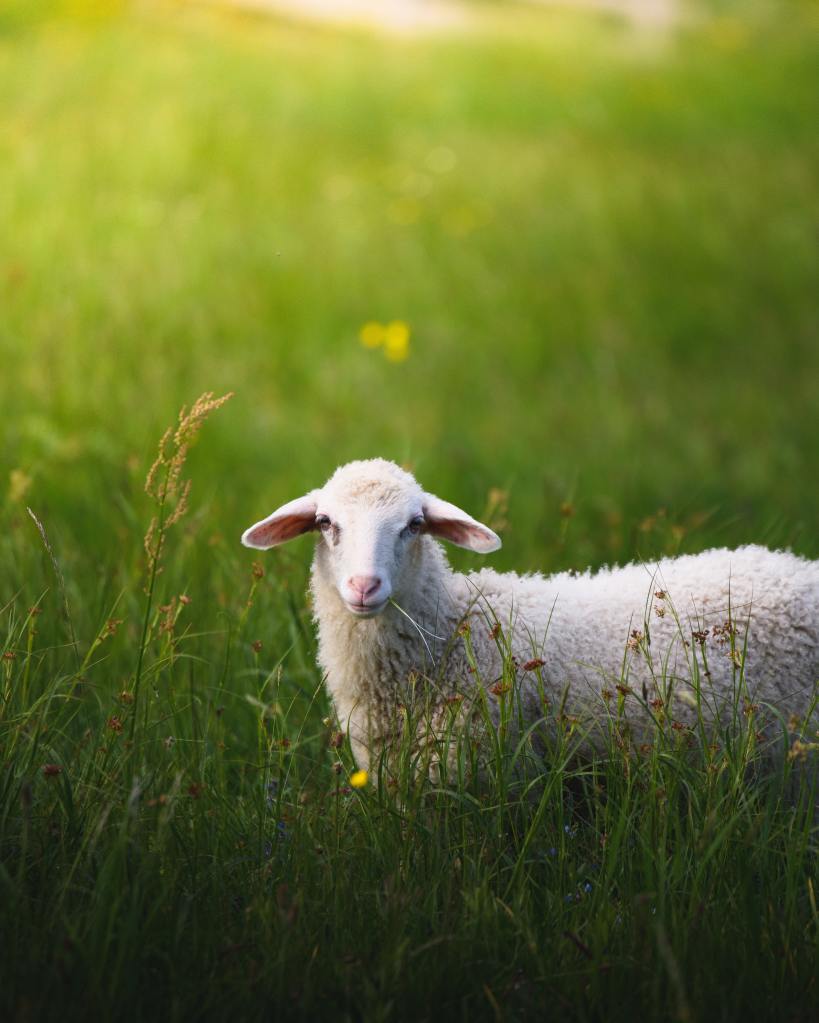
The following meditation is taken from a sermon preached at St. Peter’s Episcopal Church, Arlington, Virginia on March 22, 2020.
The twenty-third psalm is the most beloved of the one hundred and fifty psalms in the Psalter and possibly the best known and most memorized chapter of the Bible.
The KJV version of the Psalm has been read and recited by generations of Christians whose language is English. The Psalm originally was written as a prayer in poetic form in Hebrew. Hebrew poetry does not depend on rhyming, as many poems do in English, but on the rhythms of the verse and the parallel structure of the verses that build upon one another.
The opening verse of the twenty-third Psalm is composed of four words. The Hebrew name of the Lord God of Israel, the “I am who I am”, is the first word. “My shepherd” is the second word. “Not” is the third. And the last word is the verb that means,” I lack.” So literally it reads, “The Lord God is my shepherd. I lack nothing.”
When you look closely at the psalm you will note that it begins with the pronouns “I” and “my.” It switches next to the pronoun “he” when talking about God. Then suddenly and without warning the psalmist addresses God in the second person familiar, “you” (or “thou” in the KJV). Finally, it returns to the first-person pronoun, “I” of the psalmist and the second person familiar, “you,” referring to God.
This is what gives the 23rd Psalm its particular character. It is a poem that is at the same time a prayer and a statement about the faithfulness of God even in the most difficult and trying of times.
The Psalms may be categorized into several categories. It may surprise you to learn that this Psalm is usually categorized by biblical scholars as a “psalm of lament.” It is an individual lament, that is the prayer for help of an individual.
The biblical commentator Jerome Creach offers this helpful analysis of the psalm as a prayer of lament. Psalms of lament or complaint:
“have faith and trust as their cornerstones. Those who are praying feel free to haul all their baggage to God because of their intimate relationship with the Lord. They are certain God will hear and answer. The complaint psalms move swiftly from plea for help and description of enemies to assurance that the Lord will deliver. Though Psalm 23 contains no complaint and is thoroughly a statement of trust, it still belongs to the category of lament. Behind the confession of faith in Psalm 23 are trials that required the psalmist to seek the shepherd’s staff and tent for protection and shelter. All that we have of the psalmist’s experience, however, is the beautiful poetic expression of confidence in the aftermath of threat and danger. That is, surely the psalmist experienced an unspecified threat, survived, and then composed this poem.”[i]
Phillip Keller, a pastor and author, worked for eight years as a shepherd. In his book, A Shepherd Looks at Psalm 23, he illuminates the meaning of the Psalm for us in a more practical way. Sheep, notes do not lie down easily.
“It is almost impossible for them to be made to lie down unless four requirements are met. Owing to their timidity they refuse to lie down unless they are free of all fear. Because of the social behavior within a flock sheep will not lie down unless they are free from friction with others of their kind. If tormented by flies or parasites, sheep will not lie down. Only when free of these pests can they relax. Lastly, sheep will not lie down as long as they feel in need of finding food. They must be free from hunger.”[ii]
“The sheep must be free of fear, friction, flies, and famine to be contented.”[iii] And as Keller notes. The shepherd is the only one who can “provide the trust, peace, deliverance, and pasture that is needed to free the sheep. God is that shepherd. God is our Shepherd. God is your shepherd.
In the Gospel of John, Jesus describes his work and ministry as being the shepherd of God’s new covenant people saying, “I am the Good Shepherd.”
Jesus is our Shepherd. Jesus is your shepherd.
Notice that Psalm 23 begins with rest and not with frantic activity.
“The LORD is my shepherd; I shall not want.
He maketh me to lie down in green pastures: he leadeth me beside the still waters.
He restoreth my soul: he leadeth me in the paths of righteousness for his name’s sake.”
We sometimes assume that our work for God and in response to God depends on our own activity. But here is a reminder that whatever we do for God or in response to God begins with us trusting God so that we might rest. From that deep rest and refreshment comes the energy for us to do the work to which God is calling us.
The biblical commentator J. M Boice observes:
“It is important to note that “the valley of the shadow of death” is as much God’s right path for us as the “green pastures” which lie beside “quiet waters.” That is, the Christian life is not always tranquil nor, as we say, a mountain-top experience. God gives us valleys also. It is in the valleys with their trials and dangers that we develop character.”[iv]
Yet the valley has its own unique problem. The problem is fear. What is the answer to that fear? Clearly, the answer is the shepherd’s close presence, for he is the only one who can protect the sheep and calm their anxieties.
At the beginning of the Psalm, we read, “He makes me lie down … he leads me beside quiet waters … he guides me.” But at the end, we read, “I will fear no evil, for you are with me; your rod and your staff, they comfort me.” [v]
“We are never so conscious of the presence of God as when we pass through life’s valleys.”[vi]
We are living in extraordinary times. The normal order of our everyday lives has been disrupted. The social fabric that holds us together is stretched as we keep a certain bodily distance from one another so that we might protect not only ourselves from infection but also those who are the most vulnerable to it.
We are passing through one of life’s valleys. Our shepherd is the one who can protect us, God’s sheep, and calm our anxieties and fears as we traverse that valley full of so many unknown dangers. In this difficult time, may you seek rest and comfort from the good shepherd who is with us always in every circumstance of our lives.
“The LORD is my shepherd; I shall not want
He maketh me to lie down in green pastures: he leadeth me beside the still waters.
He restoreth my soul: he leadeth me in the paths of righteousness for his name’s sake.
Yea, though I walk through the valley of the shadow of death, I will fear no evil: for thou art with me; thy rod and thy staff they comfort me.
Thou preparest a table before me in the presence of mine enemies: thou anointest my head with oil; my cup runneth over.
Surely goodness and mercy shall follow me all the days of my life: and I will dwell in the house of the LORD for ever.” (Psa. 23:1–6 KJV)
Notes
[i] Jerome F. D. Creach, Psalms. Interpretation Bible Series (Louisville, KN: Geneva Press, 1998), 34.
[ii] W. Phillip Kellner, A Shepherd Looks at Psalm 23, (Zondervan, 2007). See J. M. Boice, Psalms 1–41: An Expositional Commentary (Grand Rapids, MI: Baker Books, 2005), 209.
[iii] J. M Boice, 209.
[iv] J. M Boice, 211.
[v] J. M Boice, 211.
[vi] J. M Boice, 211.
 IN THESE TIMES