
My Scottish babysitter called me an “old English tea wife” when I was eight. She wasn’t wrong. It took me sixty some years and a Chinese coffee chain to prove it. Read the full story on my Free Substack page, https://craigphillips.substack.com

CRAIG A. PHILLIPS, PH.D.
My Scottish babysitter called me an “old English tea wife” when I was eight. She wasn’t wrong. It took me sixty some years and a Chinese coffee chain to prove it. Read the full story on my Free Substack page, https://craigphillips.substack.com

Check out my new free Substack post!
Watching my Cavapoo Rosie explode into the first snowfall of the year reminded me of something we’ve all forgotten. The ability to feel unbridled joy doesn’t disappear as we grow up—it just gets buried.
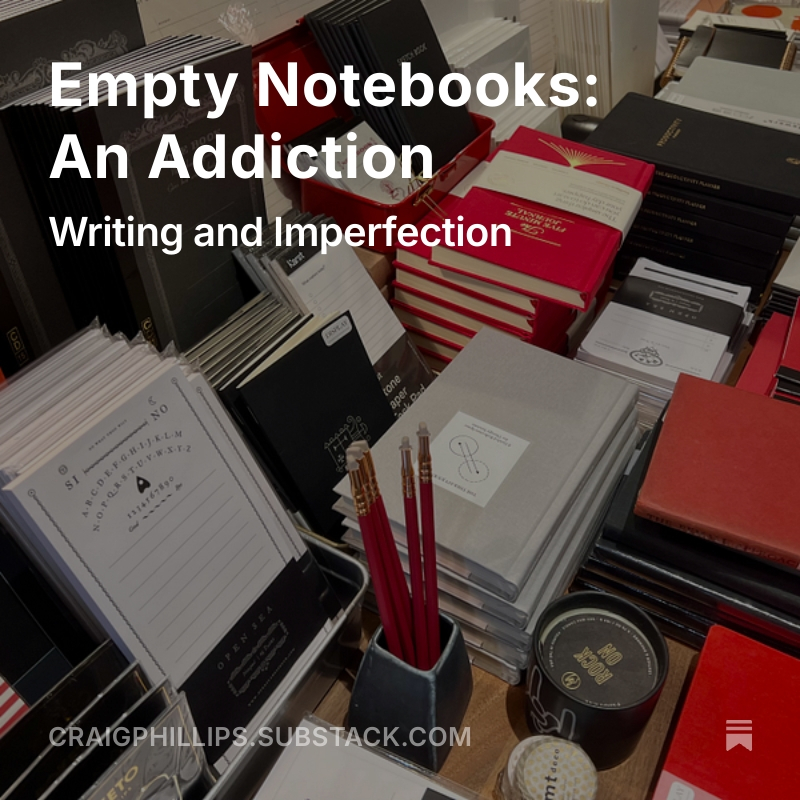
Here is the link to this post: https://craigphillips.substack.com/p/empty-notebooks-an-addiction
To my readers of this blog, please read and subscribe to my new free Substack Blog, “Everyday Life: Flourishing in These Times.”
I started this new blog as a way to reach a wider audience for my work. I will continue to post on this page. For some of my newest thoughts on a wide variety of topics, however, please subscribe now to http://craigphillips.substack.com.
Thank you for reading my writing. I deeply appreciate the time you spend reading what I write.

Please read and subscribe to my new free Substack Blog, “Everyday Life: Flourishing in These Times.”
I started this new blog as a way to reach a wider audience for my work. I will continue to post on this page. For some of my newest thoughts on a wide variety of topics, however, please subscribe now to http://craigphillips.substack.com.

There’s something deeply satisfying about writing with a pencil. The gentle scratch against paper, the distinctive smell of the graphite, and the ability to erase and refine thoughts, make pencils an indispensable tool in my writing.
When I write, I alternate between two loves: the soft scratch of pencils and the expressive flow of my fountain pens. Each brings a unique satisfaction. Having previously explored my passion for fountain pens in my blog post, “Fountain Pens: Writing Magic,” I would like to share why pencils hold an equally special place in my work.
The crown jewel of my wooden pencil collection is undoubtedly the Blackwing Pencil. The pencils come in a variety of colors and density of leads. The longer eraser, held in place by that gleaming brass clasp can be extended as it wears down or be repositioned to the desired angle and length. I maintain a variety of these pencils with differing lead densities, from soft to hard, each serving its own purpose. I like to write with extremely sharp pencils, so I find myself frequently sharpening my wooden pencils. Sometimes, I enjoy the break. It gives me time to stop and think for a moment about what I am writing. Other times, however, the need to sharpen my pencil is an unwanted interruption. When I stop to sharpen the pencil, I might irrevocably lose my chain of thought.
While I like wooden pencils, the newest Japanese mechanical pencils have introduced some groundbreaking innovations:
The Orenz Nero mechanical pencil feeds lead automatically. You don’t have to manually click the pencil, unlike so many other mechanical pencils. This engineering marvel ensures consistent lead length without adjustment, perfect for uninterrupted writing sessions.
The Uni Kurutoga Advance, by contrast, offers a self-rotating lead mechanism that automatically rotates the lead while writing, ensuring even wear and consistently sharp lines. These clever devices maintain a sharp point without me having to think about sharpening the pencil often as I write, as I would with a wooden pencil.
As someone who often works in rare book rooms and archives, pencils aren’t just a preference—they are a necessity. Many institutions ban pens to protect their invaluable collections from permanent marking. Copying material from the books is tedious. So, my choice of pencil varies based on the task. When I find that I am erasing often, I switch to my Blackwing wooden pencils. When I find that I am spending too much time sharpening them, I turn to my Kurutoga Advance mechanical pencil. For completely uninterrupted work, I rely on my Orenz Nero pencil with self-advancing lead.
Both fountain pens and pencils offer distinct forms of creative freedom. My fountain pens are perfect for capturing rapid-fire thoughts and brainstorming.
My premium pencils offer a different kind of freedom. Their smooth graphite provides its own form of flow. It offers the liberty to erase and adjust my ideas as I write. This makes them perfect for evolving ideas—whether sketching concepts or refining drafted thoughts.
In this age of keyboards and touchscreens, I find deep satisfaction in choosing analog writing tools. Each stroke requires intention, and the maintenance rituals—from filling a pen to sharpening a pencil—have become cherished moments. These pauses serve as valuable punctuation marks in my thinking process.
The analog tools of pencils and fountain pens connect me to the physical act of writing. Whether using my Blackwing with its smooth graphite gliding along the paper, or watching my fountain pen dance across the page, each represents a valuable approach to capturing and developing ideas. Mechanical pencils bridge these worlds, offering convenience without sacrificing tactile pleasure. It Is wonderful to embrace the unique character of each writing tool, allowing me to appreciate their distinct qualities and the maintenance demands they require, thereby enhancing the creative process.

This morning, I woke to the sharp chill of a New Hampshire winter. The thermometer at 6 a.m. read 1°F. Outside, a light layer of snow covered everything, softening the edges of the world in its quiet way. At this hour in Winter, just before sunrise, there is just enough light over the horizon to hint at the day ahead.
I am wrapping my hands around a pottery mug my wife made for me. It’s one of those small, tangible things that brings an out-sized amount of joy. The mug has a beautiful blue glaze. Its handle is wide and perfectly designed for my fingers. As I sipped my coffee, I couldn’t help but admire its warmth in my hands. Making and drinking morning coffee is a ritual that grounds me.
Every morning, I bring my wife coffee in bed. It’s a ritual I’ve honored for years, a small gesture that says more than words ever will. Back when I started doing this, I’d make pour-overs, carefully swirling water in slow circles over the freshly ground beans. These days, I rely on the Dutch Moccamaster, a marvel of practicality and design. It brews coffee with the precision of a pour-over but with less fuss—a reliable companion for early mornings like this.
I think about why I do it. It is the satisfaction of starting the day with intention, a simple act of love as she slowly wakes up. It is another ritual that shapes our days and, by extension, our lives. The act of making coffee, the artistry of a handmade mug, the quiet minutes before the world wakes up—all of these feel like anchors in the chaos of life.
Cold winter mornings in New Hampshire have a way of reminding me of life’s essentials: warmth, love, and the simple joy of sharing. As I hand my wife her morning coffee, I realize that in what I am writing now, I’m trying to capture a moment, not for its grandeur but for its simplicity.
Sometimes, noticing the beauty in the everyday—cold mornings, warm mugs, and small acts of love—is enough.
“What’s my line?
I’m happy cleaning windows
Take my time…
“I’m a working man in my prime
cleaning windows.”
Van Morrison, “Cleaning Windows”
I was walking on 15th Street in downtown Philadelphia on my way to meet a friend for lunch when I felt water drops on my head. Because it was not raining at the time, I looked up to see where the water was coming from. There perched on the side of a large downtown skyscraper was a window cleaner attached to the building by a lone safety wire. In his hands were a bucket and a “v.” Directly in front of me was a mother pointing upward to showing her son the window-washer hanging precariously from the side of the building.
The lyrics to “Cleaning Windows,”one of my favorite Van Morrison songs, immediately came to mind. It’s a song Van Morrison wrote about his work from 1961-62 when he and his partner Sammy Woodbury cleaned the windows of the terraced homes in Belfast. The song reveals the simple joy and contentment that Van Morrison found in the rather ordinary task of cleaning windows.
Oh, the smell of the bakery from across the street
Got in my nose
As we carried our ladders down the street
With the wrought-iron gate rows
Oh, Sam was up on top
And I was on the bottom with the v
We went for lemonade and Paris buns
At the shop and broke for tea
I have always found this song to be a profoundly spiritual song. It points to the realization that people in many times and places have had, namely that God is often experienced in the utmost simplicity of everyday life. Christians perhaps best know the kind of spirituality that finds God in the midst of everyday activities from the witness of Brother Lawrence.
Brother Lawrence of the Resurrection, born Nicholas Herman in 1611 in French Lorraine, was a large and clumsy man who was always breaking or accidentally smashing things. He had served as a soldier until wounded and then as a footman. His conversion at the age of eighteen happened as he noticed a leafless tree against the background of snow and thought of the wonder of God that would be made manifest in the spring when that tree again bloomed. In 1666 he joined the monastery of the Discalced Carmelites of Paris as a lay-brother to atone for his own perceived inadequacies but instead found only the grace and mercy of God. He was put to work in the monastery kitchen where he worked for the next 25 years. He died in 1691 around the age of eighty.
The Practice of the Presence of God, first published in 1691, contained excerpts from conversations with him and from his letters. In the one of the conversations he remarked “that he was more united with God during ordinary activities than in religious exercises, in which he was generally afflicted with spiritual dryness.” He observed that, “the time of business does not with me differ from the time of prayer.”
In the noise and clatter of my kitchen, while several persons are at the same time calling for different things, I possess God in as great tranquility as if I were upon my knees at the blessed sacrament.
Where Van Morrison finds contentment in the everyday task of window cleaning, Brother Lawrence finds the presence of God in the midst of the noise and clatter of his kitchen.
Brother Lawrence’s “practice of the presence of God” was really quite simple: wherever he found himself, he reminded himself continually that God was always near to him. This practice meant that he never strayed far from the well of God’s merciful presence and explains how in the midst of a busy kitchen, he was able to find rest and refreshment in God’s presence.
 IN THESE TIMES