The non-profit, A Faith that Does Justice, has published my essay on Tom Petty’s song, “Crawling Back to You,” that first appeared in a shorter version on my Substack page, https://craigphillips.substack.com, as “The Weekly Word.”
This revised contribution adds additional content relating the song to the Collect for the 8th Sunday after the Epiphany from the Book of Common Prayer.
I hope you enjoy reading this. If you are already subscribed to this blog site, “In These Times,” please consider also subscribing to my new free Substack page:
A Faith that Does Justice has published another contribution of mine as the “Weekly Word.” The article poses the question, why do the people of God often fail to appreciate, or even notice, God’s many blessings and be thankful for them?
The non-profit, A Faith that does Justice, has published another contribution of mine about one of my favorite short prayers from the (Anglican) book, A St. Francis Prayer Book. It is entitled, “For gentleness in my dealings.”
The non-profit, A Faith that Does Justice,” has republished another widely read blogpost of mine from this site, “In These Times.” Here is the link to the repost:
This site features my writings on everyday life, but occasionally writing from my work as an Episcopal Priest. I am retired now from that work, but am still active as a blogger and an academic writer.
The non-profit, A Faith that does Justice, has published my third contribution to their column, “The Weekly Word.” This post is the third of four columns that they have chosen to appear on their website. It focuses on the relationship between healing and justice in the teaching and actions of Jesus and on how you, the reader, might enact that justice in the world today.
As I have gotten older, I am realizing more and more that my own grandparents did not live much past my current age. I find myself wondering what their life was like at this same stage in my life. I also find myself wishing that I had asked them more questions about their lives.
My father died at the age of 58 as did his father. My maternal grandmother died in her early 80’s, but my other two grandparents died in their early seventies, an age I am rapidly approaching.
My grandparents all lived through two World Wars and the Great Depression. As I was still a teenager when two of them died and a young married person when my maternal grandmother died, I did not think to ask them much about their lives. Now, I wish I had been more inquisitive and willing to listen to them.
As a teenager, I was an avid fan of military history from the Napoleonic Wars through WWII. I assembled and painted numerous plastic models of airplanes, warships, and tanks of WWI and WWII. I even painted some 2000 miniature plastic figures from the Napoleonic Wars, each one with an authentic uniform. I perhaps was one of the few youth who ordered books in French, with pictures of Napoleonic Uniforms and I had accounts with English booksellers for the same purposes. I had quite a collection of military figures, but when I returned home from college one year, I found that my parents had cleared out my bedroom to make it a more generic guest room and they threw them all out along with my models.
Bob, my mother’s brother, a private in the 29th Infantry Division of the United States Army, landed on Omaha Beach as part of the D Day Landings. He was separated for weeks from his unit, but eventually regrouped. Shortly after reuniting with his unit, he was wounded in the Battle of Saint-Lô, sometime between July 7 and 19, 1944. He was hit in the back of his right arm, most likely by shrapnel from explosives mistakenly dropped by American planes from behind the front lines. As an enthusiast of books and movies on WWII, I begged my uncle to tell me more about what he experienced overseas in combat, but my family always steered me away from that discussion with him. If I asked him alone, I got little out of him. The only story I ever heard from him was that as they approached the shore the landing craft that held him and his fellow combatants hit a German mine. Most of the soldiers drowned with 50 pound packs still on their backs, but my uncle, an excellent swimmer, was able to drop his pack and swim to shore, In the confusion, it took him three weeks to be reunited with his unit. He never really recovered from his ordeal, living most of the remainder of his life with his parents before dying at the age of 67 at the Soldier’s Home in Chelsea, Massachusetts. I remember that he had an abiding dislike of the nasal sound of the French language. That is what he remembered hearing, but not understanding, after he was wounded and transferred from hospital to hospital in the vain attempt to restore his damaged arm. Apart from that I know little else about his wartime experience.
Over the years, my uncle became more and more of a recluse, although to the family, he talked endlessly about cars and every new model that appeared. When he returned from the war, he felt that, because of his disability, he no longer was good enough for his girlfriend, and that he would only be holding her back from a happy life. Without telling her anything directly, his apparent disinterest in her drove her away gradually. That’s all I know. I realize now that he was most likely suffering from depression and some sort of PTSD, which was not understood well at the time. The term “shell shocked,” which emerged from the experience of troops from WWI, came the closest to describing his experience. His parents were endlessly frustrated by what they thought was my uncle’s lack of motivation and chalked it up to laziness. As a result, relations between my uncle and my grandfather were fraught. I was aware of this at the time, in the way a child knows that something is not quite right, but I loved to be with my uncle and looked up to him in a way that even now I can’t say exactly why.
After the war, Bob found it difficult to find a job. Before the war he had studied business, but the fact that, with his wounded right arm he was not able to shake hands, meant that few wanted to hire him. He ended up packing and shipping boxes in a factory that produced box toes for the shoe industry in Haverhill, Massachusetts.
Uncle Bob was my only uncle. My father was an only child and my mother only had one brother. o because Bob never married and had children, I never had an aunt or any first cousins. He was it. I wrote what I did here, so that my uncle’s story, however incomplete, is not entirely lost forever.
What remains of a person after they have died? I have none of my uncle’s personal effects. For a time we had his bed frame, but that is no longer with us. My mother framed his purple heart and other medals from the war and hung them on her wall. So what remains, other than the memories of those who, like me, knew him and still remember him? There are fewer and fewer people alive who knew Bob and knew some of his story. After all, he, like my father, was born about 100 years ago. What will happen when we too die and those memories are lost forever?
I began thinking about some of the events in my own life that I think were important and how I would like my children and grandchildren to know about them when I am no longer alive. I think it is time to start writing some of that down, because they, like me at their age, will not think to ask what later in their lives they might wish to know. My hope is that my memories will mix with their memories of me and perhaps that bundle will enrich their lives as well.
What would you want subsequent generations to remember most about you?
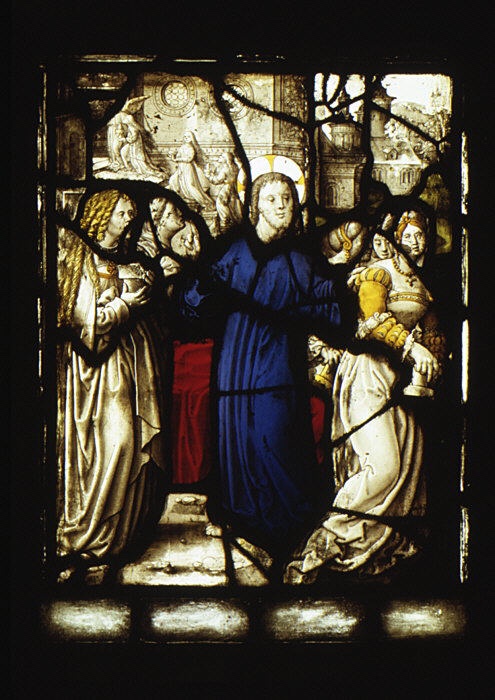
The Parable of the Wise and Foolish Virgins (one of a set of 12 scenes from The Life of Christ) Maker: Jan Rombouts (South Netherlandish (Duchy of Brabant), 1475–1535). From the Metropolitan Museum of Art.
In Mt. 25: 1-13, we find Jesus’ parable of the wise and foolish bridesmaids which concerns their preparedness at the parousia, the return of the Jesus the bridegroom at his second coming: five were ready when the bridegroom returned at an unannounced time, but five were not. The five who were prepared with oil in their lamps could not share what they had because, readiness is not something you can share. It is something you have to cultivate within..
This story of the bridesmaids allows me to do something I rarely do in the pulpit and that is to connect what I have been writing on as an academic with what I preach. In the past ten years I have published numerous articles and chapters on the work of Giorgio Agamben. (You can find the bibliographic information on the page of this blog listing my academic publications.)
Giorgio Agamben is one of the most prominent continental philosophers alive today. He is a former student of Martin Heidegger, and even though he could be described as an atheist and somewhat of a philosophical anarchist, his work is based primarily on religious and theological texts, including a commentary on St. Paul’s Epistle to the Romans and a book on St. Francis and monastic rules. I became interested in him because he was the Italian editor of the writings of Walter Benjamin on whom I wrote one half of my doctoral dissertation and because of his use of theological texts in his non-religious philosophy. Agamben, I might add, is not easy to read or to understand.
In March 2009, Agamben was invited to Notre Dame Cathedral in Paris to give a lecture on his critique from his own philosophical perspective on the Roman Catholic Church. This address was subsequently published as The Church and the Kingdom. [1]
The earliest Christians, as is evident in the parable of the wise and the foolish bridesmaids in the Gospel of Matthew and in St. Paul’s first letter to the Thessalonians expected that the crucified and resurrected Jesus might return at any moment. St. Paul told Christians in his early writings that they should make no drastic changes to their life because Jesus was going to return any moment. If they were not married, for example, they should hold off marrying because the Lord might return at any moment. The present form of the world, he said more or less, is passing away, so don’t get too attached to it. (1 Cor. 7:31).
In his address in Paris, Agamben observed that “the Christian church has ceased…to sojourn as a foreigner,” and begun to dwell in the world and “live as a citizen in the world and thus function like any other worldly institution.” As the years went on and Christ did not return, the church began to settle in the world and put down roots. It ceased to sojourn and began to dwell. This for Agamben is the root of his critique of the church. [2]
The difference between sojourning and dwelling is something like the difference between being nomadic and settling down and building permanent dwellings. When you begin to dwell you get tied down to your own possessions and lose the ability to move quickly when needed, or adapt to changes.
St. Paul proclaimed freedom from the law. He urged Christians to live in the Holy Spirit in joyous freedom from the law. When the church began to dwell in the world, it became like other worldly institutions and set up legal structures that effectively replaced the law from which they, in Christ, had been freed. Agamben investigates St. Francis and other monastic rules, which in Latin are called regula (from which we derive our English word regular) to see if he could provide an alternative today for law (Latin, lex), investigating how one might free oneself from servitude to law in all of its contemporary manifestations.
To address this, Agamben does something quite interesting. He turns to St. Francis of Assisi and the first Franciscans. Francis wanted to live his life according to one rule only, namely that he live as Jesus Christ lived. He, therefore, renounced all his possessions so that he would be free from them and thus able to respond to Jesus in every area of his life. Francis became a kind of nomad. He gave up the idolatry of his possessions and found freedom. In his poverty he found exhilaration and joy. In subsequent centuries after Francis, Franciscans tried to figure out how, if they were going to live a life of perfect poverty, they could “use” things without owning them. Agamben turns to these texts and discussions to glean what he can for his own philosophical and political work.[3]
Returning to the story of the bridesmaids, five of them were ready but five were not. Why were the other five not ready? The story doesn’t tell us. Without reading too much into the parable we could surmise that they had been busy. They put off getting oil because they had other things to do, which at the time seemed more important.
Could it be that they had ceased to sojourn, and begun to dwell? They had become so attached to the things of this world and to the care of them, that they were not ready and prepared when the bridegroom (who in this story is clearly the person of Jesus Christ) returned. They had been claimed by what they owned and not by the person who owned them, Jesus Christ. This idolatry of things and possessions prevented them from the freedom to follow Jesus wherever he led.
The parable of the wise and foolish bridesmaids ends with these words, “Keep awake therefore, for you know neither the day nor the hour.” We know neither the day nor the hour of the Lord’s return. So, prepare yourselves. Begin by examining the things that hold you back—that tie you down—that enslave you— that keep you from responding to Jesus and his call to you. Can you begin to use things without owning them? Can you begin let go of the things that hold you back that keep you tied down? You can only be prepared for yourself. You cannot be prepared for someone else. “Keep awake therefore, for you know neither the day nor the hour when the bridegroom will return.” The question for you is, “when he does return, will you be ready?”
[1]Agamben, Giorgio, Leland De la Durantaye, and Alice Attie. The Church and the Kingdom. (London ; New York: Seagull Books, 2012).
[2] “…The Christian church has ceased to paroikein, to sojourn as a foreigner, so as to begin to katoiken, to live as a citizen and thus function like any other worldly institution. See Agamben, The Church and the Kingdom, p. 4.
[3] Agamben, The Highest Poverty. Monastic Rules and Form-of-Life. (Stanford, California: Stanford UP, 2013.
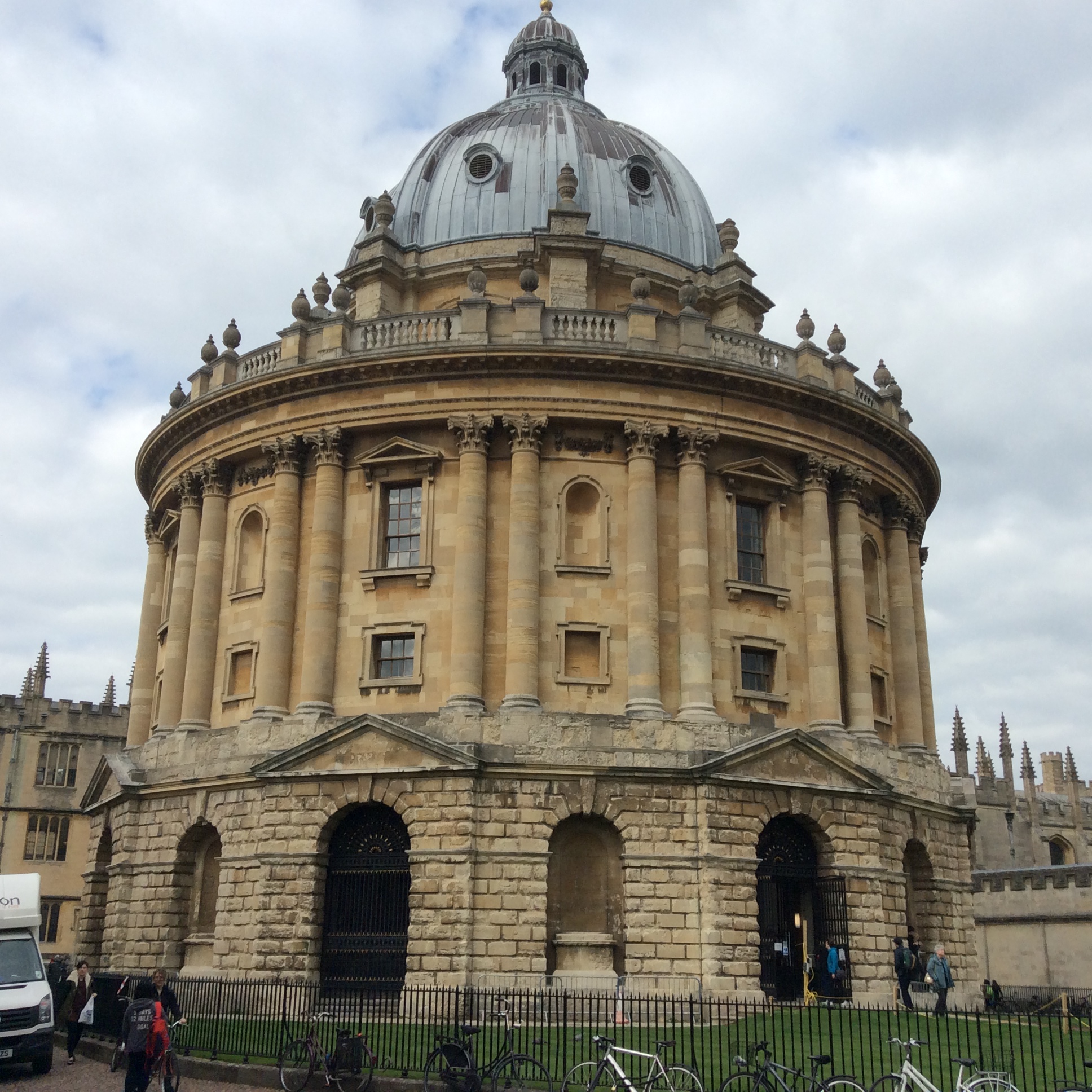
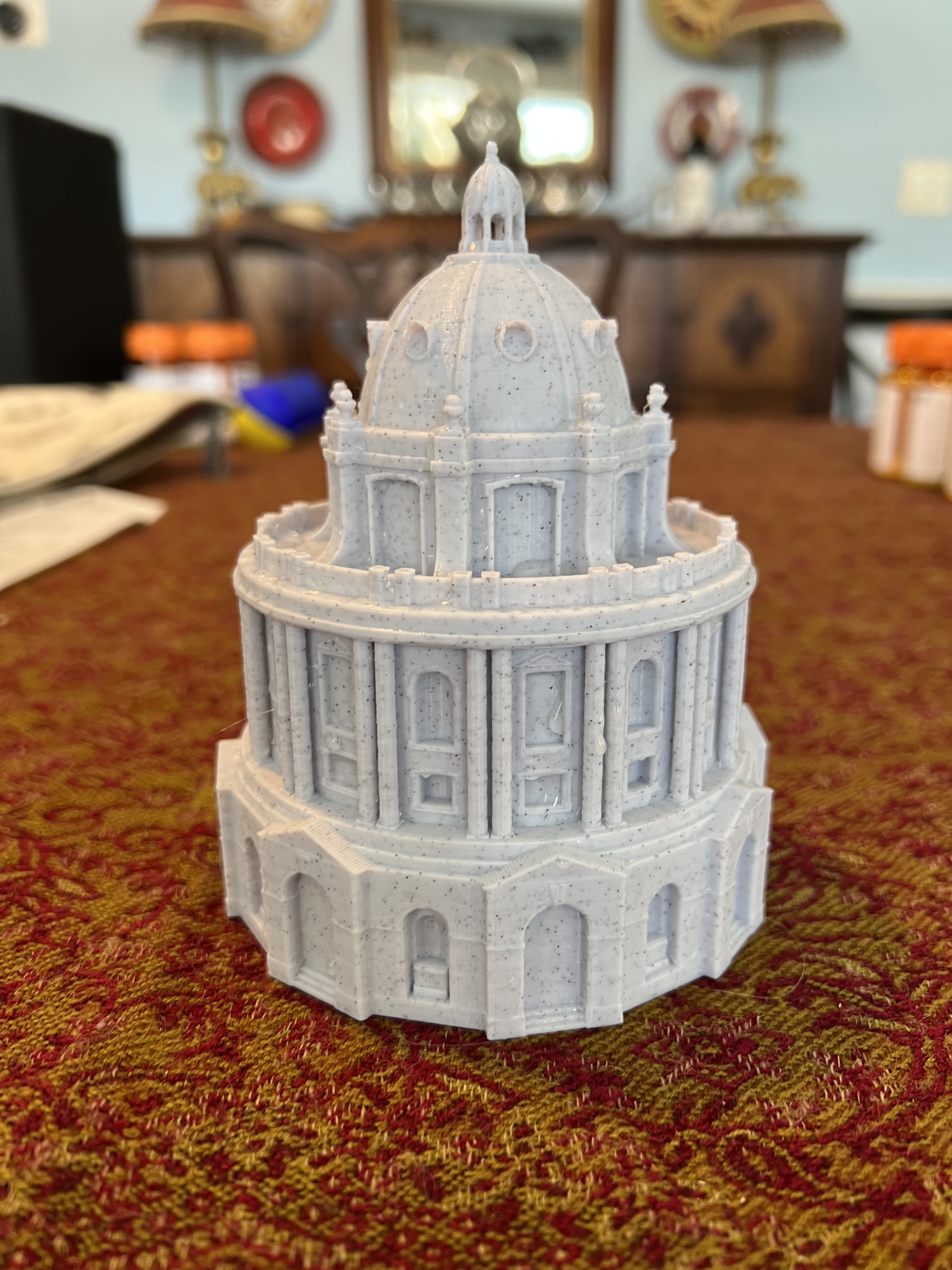
RADCLIFFE CAMERA, OXFORD UNIVERSITY3D PRINT OF THE RADCLIFFE CAMERA. 3D MODEL BY PHC DESIGN
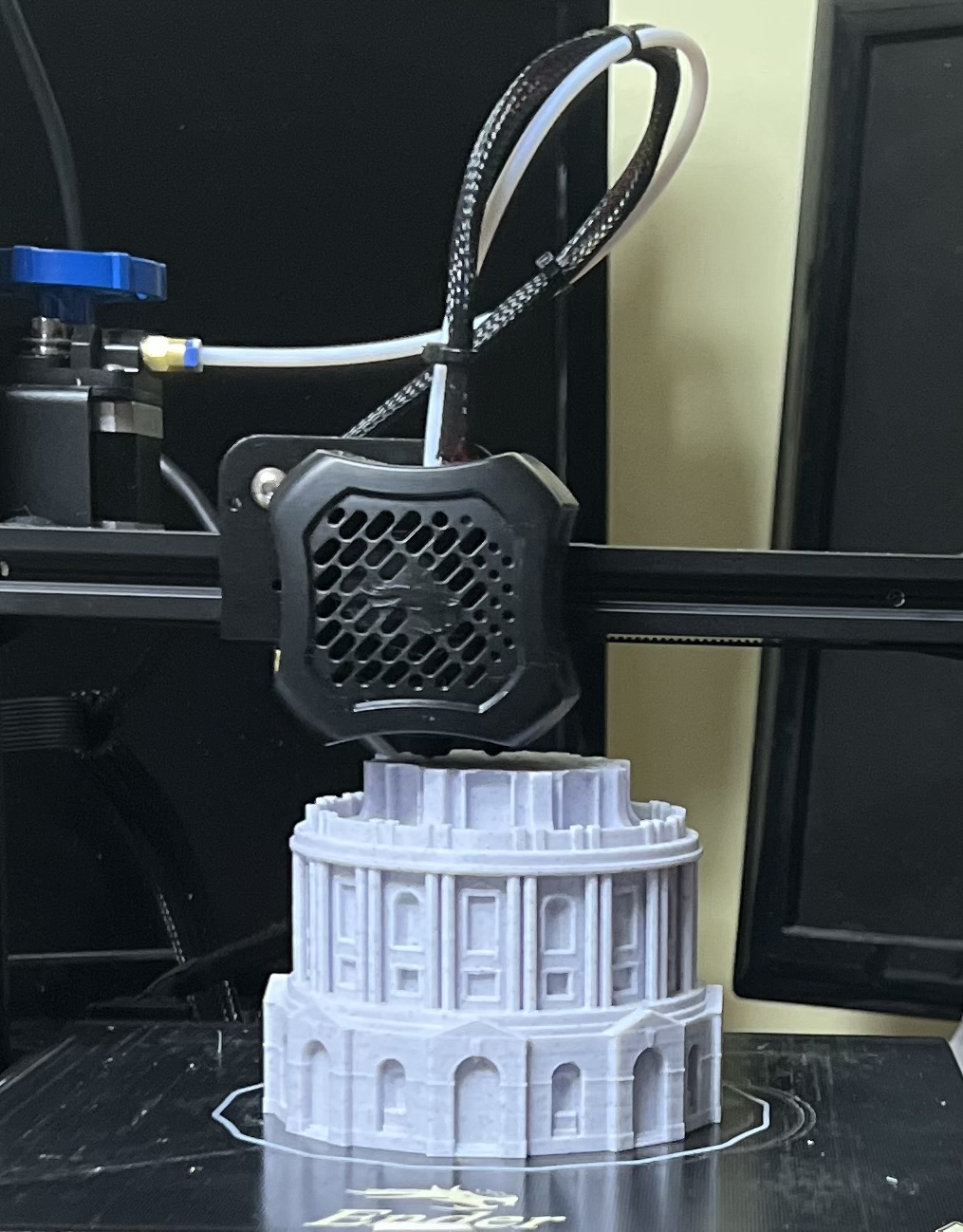
I’ve found a new hobby—3D printing. It’s a fun way to make something from nothing. It starts with a 3D computer model that has been designed in a CAD program. Thousands of free models are available on the internet on sites such as Thingverse and Printables. Once the file you want to print is downloaded, you have to convert it in a program that tells the printer how to slice the model so that it can be printed. The 3D printer lays down one thin layer at a time on a heated platform until it builds up the entire model. I am printing with PLA filament. PLA (Polylactic Acid) is made from renewable, organic sources such as corn starch and sugar cane.
3D PRINT IN PROGRESS
A few years ago, 3D printing was out of reach for me. The cost of entry was just too high. Now, with new 3D printers on sale for less than $200, the hobby is much more accessible for persons like me who just wanted to try it out for fun.
So far I have made a number of really useful parts and gizmos for things around the house. I make a tamping stand to hold the portafilter of my expresso machine and a funnel that fits to it for dosing ground coffee into the portafilter, a bracket to hold a drafting lamp (I lost the original part who knows where.) I have made cases for the Arduino motherboards for my small-scale electronic projects, a model of the Radcliffe Camera, the domed library at the center of the campus of Oxford University where I have done some academic research, a small model of the Library of Congress, a Lord of the Rings bookmark, a small Tardis from the Dr. Who television series, and any number of other gizmos and chotskies.
Along the way I have also had to become somewhat of an expert in modifying, repairing, and upgrading my machine, including connecting and disconnecting various wires to the motherboard. Instructions on how to do these things are difficult to find. One a recent repair, I reordered a new “hotend” with cables attached. I had damaged the original hotend when I made a mistake replacing the brass printer nozzle. The new part arrived with no instructions whatsoever on how to install it—just the part attached to numerous wires. While installing it, I foolishly disconnected more wires than I had intended. Fortunately I had the foresight to take a picture of the motherboard so that I could correct my mistake. On repairs and upgrades like this, YouTube videos and other Internet chat groups can help, but often you just have to figure out how to correct the mistakes you have made on your own.
How to manually level the printer bed and how to get the print to stick to the printer bed are also things you have to learn on an entry level printer. While there are numerous upgrades one can get to make these things easier, it is good first to learn how to do these things manually, as that helps troubleshoot printing issues you might have later on even with upgraded printers. In spite of all the issues I have named above, I find that I get a great deal of satisfaction from using my printer and seeing what it can produce.
Learning the ins and outs of 3D printing has expanded my horizons. It has allowed me to look at the world in a different way. When I look at objects in the world I realize that the whole I see in these objects is layered of many parts. I can imagine how a flower petal or a the leaf of a plant is layer upon layer of cells of different shapes and sizes. When I get ready to 3D print an object, whatever it is, after carefully setting everything up, I feel that I am able to make something that did not exist before. It is like making something out of thin air. It’s magic.





 IN THESE TIMES