WE ARE EUCHARISTIC BEINGS— THE IMPORTANCE OF GIVING THANKS

“Do not worry about anything, but in everything by prayer and supplication with thanksgiving let your requests be made known to God. And the peace of God, which surpasses all understanding, will guard your hearts and your minds in Christ Jesus.”  Philippians 4: 6-7

A few years I was talking to a stewardship consultant about churches and people we had met in our separate work and travels around the country. He asked me if I knew a certain priest from the Diocese of Oklahoma, the diocese in which I was ordained almost forty years ago. It happened that I did. Once, when newly ordained, I was having some difficulty in the mission congregations I served. This priest went out of his way to help me and I had not forgotten it. Even though I had not seen him since I moved away from Oklahoma in 1984, I knew that I needed to thank him once again. I certainly had thanked him at the time but I wanted to thank him once again to let him know that I had never forgotten what he had done for me. And so I called him up at the church he was now serving and expressed my thanks to him once more. We had a wonderful conversation. We caught up on what had happened to us and our families over the intervening years and we remembered what it was like for us to be young priests together in the Diocese of Oklahoma. I do not know how he felt after my phone call, but I know that for me I had completed something. I had given thanks and that, for me,  had made all the difference.

One of the things I have learned over the years of my life is that human beings are the happiest when they are thankful. Expressing our thanks to God and to one another is essential to our well-being.

Most Episcopalians know that the word eucharist is a Greek word meaning “thanksgiving.” When Episcopalians gather for worship they celebrate and offer to God a “Holy Thanksgiving,” a “Holy Eucharist.” This form of the Holy Eucharist is shaped by four actions. Jesus took bread, gave thanks to God, broke the bread, and distributed the bread to his followers. On the night before he was betrayed Jesus took bread in his hands, lifted it towards the heavens, with the usual ritual glance upwards towards the heavens, gave blessing and thanks to God. As he broke it he told his followers “this bread is my body” broken and given for you. He did the same with the cup of wine. As he offered the bread and the wine he added these words: “Do this in remembrance of me.”

When we relive this story together we often focus our attention on the suffering of Jesus. That is, of course, central to this event. At the same time, however, we often forget the central role of thanksgiving in this event. What if we were to tell the story this way: Jesus himself is a Eucharistic Being who, in thanksgiving to God, gave his own self for us and for our salvation? When we make Eucharist together we do so to give thanks to God in Christ and through the Holy Spirit for the life, death, and resurrection of Jesus who gave himself for us in thanksgiving to God. When we look at the Eucharistic event through the lens of thanksgiving it becomes evident that our participation in the eucharistic rite is an expression of thanksgiving to God.

Every time we make Eucharist together, we give thanks to the God who so wonderfully created us and to the God who so wonderfully redeems us.

When we make Eucharist together we give thanks to God for all that we are and all that we have. When we do so we are reminded that we like Jesus are also eucharistic beings, that is, we are people who are created by God to give thanks.

We Christians worship a God who is revealed in stories in which God showers blessings on the people of ancient Israel and on us in the person of Jesus Christ. God is not an abstract idea for us, but rather a God revealed in stories of love and concern for God’s people. When you look through the stories of the Scriptures you will see that God primarily is a giver. God always wants to give to God’s people. God showers blessings on God’s people because that is the nature of God.

From the earliest stories in the scriptures, God’s people have responded to the gifts God has given them by giving thanks in return. We are created by God and given life so that we might give thanks. The human being, in other words, is a eucharistic being. We are beings created to give thanks. If that is the case, then to be fully human, we have to learn how to give thanks to God and to do so in all circumstances.

St. Paul understood how important thanksgiving is to our lives. In 1 Thessalonians 5:18 he writes, “Give thanks in all circumstances; for this is the will of God in Christ Jesus for you.” In Philippians 4:6 he writes, “Do not worry about anything, but in everything by prayer and supplication with thanksgiving let your requests be made known to God.” In Colossians 3:17 Paul writes, “And whatever you do, in word or deed, do everything in the name of the Lord Jesus, giving thanks to God the Father through him.” In all of these examples — and there are many more like it in the New Testament— the word “eucharist” is central. We are who we are because we give thanks, because we are eucharistic beings.

When you begin to realize how central giving thanks to God is to your very being, to being the full person that God has called you to be, you will find that it will change the way you live.

Remember that you were made to give thanks and then offer to God the giver heartfelt thanks for all the gifts you have been given—food, family, shelter, friends, and so much more.

MEMORIZING HOLY SCRIPTURE

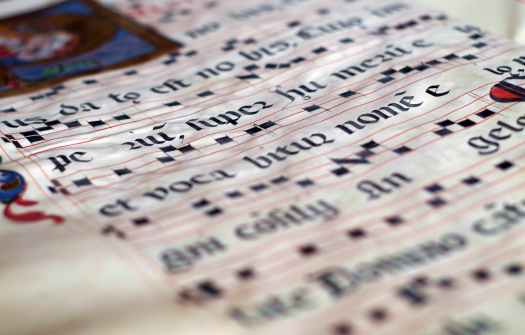
ancient blur calligraphy czterolinia
Photo by Pixabay on Pexels.com

I first became an acolyte in 1967 at St. John’s Episcopal Church in Tulsa, Oklahoma.  In those days the clergy, acolytes, lay readers and chalicists gathered in the sacristy prior to the service for prayers while the clergy vested and prepared for the service. Prior to the service the altar guild arranged the vestments on a vesting table in their traditional arrangement. As the clergy vested the people gathered prepared for service at the altar by confession and absolution and by the reciting of Psalm 43 in versicle and response format.  Together we prayed: “O send out thy light and thy truth, that they may lead me, and bring me unto thy holy hill, and to thy dwelling; And that I may go unto the altar of my God, even unto the God of my joy and gladness….” The order for this brief “service” of preparation was posted on the wall of the sacristy and on cards we held in our hands. As a result of this time of preparation, Psalm 43 was the first lengthy passage of scripture that I committed to memory.

The prayer book of the Episcopal Church in those days was the 1928 Book of Common Prayer. What many people do not know is that the Psalter in that prayer book was not taken from the King James Version of the Bible (1611 AD), but from the “Great Bible” (1539 AD) of Matthew Coverdale, commissioned in fact by Thomas Cramner, the author of the first English Prayer Book of 1549. The official English Prayer Book of 1662 and the 1928 Book of Common Prayer were almost everywhere influenced by the wording of the King James Bible except when it came to the psalms. Here tradition prevailed. When these two prayer books were issued, people were not willing to accept the newer wording of the King James Psalter but preferred in their place the familiar wording of the psalms from the Great Bible, already known and memorized by many of them. In an age when many could not read, the church could not afford to change the wording of the psalms in every generation, and so the tradition held. Even in 1928, Episcopalians were not willing to give up the familiar words of the psalms from the Great Bible for another translation, even one as venerable as the by-then tried and true King James Version.  When it comes to our liturgical forms, we Anglicans can sure hold on to our tradition!

In his “Golden Epistle,” the 12thCentury Cistercian monk William of St. Thierry urged his fellow monks to memorize passages of Holy Scripture:

Some of your daily reading should also each day be committed to memory, taken as it were into the stomach, to be carefully digested and brought up again for frequent rumination…

William hoped that as his fellow monks ruminated on the words of scripture and committed them to memory that the desire for prayer would arise within them.

It is a great comfort in times of prosperity and adversity to be able to recall by memory the promises and assurances of Holy Scripture.  I am still working to memorize the canticles and many of the psalms from the 1979 Prayer Book.  I have learned to love their words and wonderful phrasing. At the same time, Psalm 43 from the Great Bible is still firmly committed to my memory; I can recite it today as easily as I can the Lord’s Prayer.  In times of trouble, the words of this psalm comfort me and lead me to prayer.

5  Why art thou so heavy, O my soul? * and why art thou so disquieted within me?

6  O put thy trust in God; * for I will yet give him thanks, which is the help of my countenance, and my God.

LIFE TOGETHER IN CHRISTIAN COMMUNITY 

building architecture church monastery
Photo by Gratisography on Pexels.com

How very good and pleasant it is when kindred live together in unity!  (Psalm 133:1)

Because people are imperfect, there will always be conflict whenever they gather together to do anything.  The same is true of the church.  The realization that this is true is not enough; we Christians are called to form communities of forgiveness and reconciliation that are markedly different from others in the world in which we live.

In every letter St. Paul wrote, he offers advice and counsel to his fellow Christians on how are to behave towards one another.  He continually reminds all members of the body of Christ of the danger of dissension and exhorts them to practice love and respect for all members of the church.  Paul’s zeal is unflagging on this topic because he was keenly aware of how jealousies, passions, divisions, anger, lust, and all other sorts of human failings could weaken, and even destroy genuine Christian community.

In the Prayer of St. John Chrysostom, read at the end of Morning Prayer (BCP 102), we are consoled by the promise from the Gospel of Matthew “that when two or three are gathered together in his Name,” the Lord “will be in the midst of them.” The original citation from Matthew does not directly concern the presence of God at our corporate worship services but rather concerns the process by which disputes were to be settled within the early Christian community to which the gospel writer belonged.

If another member of the church sins against you, go and point out the fault when the two of you are alone… But if you are not listened to, take one or two others along with you, so that every word may be confirmed by the evidence of two or three witnesses….  Again truly I tell you, if two of you agree on earth about anything you ask, it will be done for you by my Father in heaven. For where two or three are gathered in my name, I am there among them (Mt. 18:15-17; 19-20).

Similarly, in the sixth century Rule of St. Benedict, St. Benedict outlines how monks, who live day in and day out in close quarters, should behave towards one another:

The monks are to bear with patience the frailties of others, whether in body or behavior.  Let them strive with one other in obedience to one other. Let them not follow their own good, but the good of others. Let them be charitable toward their brothers with pure affection (Chapter 72: 5-8).

This is one of the best descriptions that I know concerning what it means to love our neighbor, particularly the members of our own church community. Although Benedict wrote for a monastic community, his words apply to life together in any Christian community. Let’s examine each point.

  1. To bear with patience with the frailties of others

In the prayer that Jesus taught his disciples, the “Lord’s Prayer,” we are reminded that if we ourselves want to be forgiven, we have to learn to forgive others. That is because, as Jesus reminds us, we most often are troubled most by the faults in others that closely match our own faults. “How can you say to your neighbor, ‘Let me take the speck out of your eye,’ while the log is in your own eye?” (Mt. 7: 4-5).

The path towards Christian maturity is long and arduous. We cannot expect to be perfect all at once.  As we practice Christian charity and patience with others, we slowly begin to grow and mature ourselves. We, then, must learn first to be patient with our own faults and frailties and not to focus too soon on identifying and criticizing the faults of others.

  1. To live in obedience to one another

In the Rule of Benedict, obedience to the authority of the abbot, the spiritual leader of the monastic community, was a foundation to the stability of the monastic community. In earlier monastic rules, the authority of the abbot was absolute. Benedict softened this by reminding the monks that they were to live in obedience to one another because “by this road of obedience they shall travel to find God” (71). In Christian community we can learn from the advice, and even the loving admonitions, of others.  Benedict realized that sometimes we are not our own best guides. We can become lost and in need of the direction that others can offer us.

  1. To seek the good of others above our own good

Here Benedict reaffirms the witness of St. Paul who wrote, “Let no one seek his own good, but the good of his neighbor ” (1 Corinthians 10:24). In Christian community our life together should always center around our efforts to “edify,” one another, that is, to build up and support them and not to destroy them by our selfish attempts to draw attention to ourselves and our own needs.

  1. To be charitable with pure affection towards one another

When we read the Epistle to the Ephesians, alongside the Rule, we can see that Benedict’s ideas are thoroughly infused with the spirit of the writings of St. Paul.

I…beg you to lead a life worthy of the calling to which you have been called, with all lowliness and meekness, with patience, forbearing one another in love, eager to maintain the unity of the Spirit in the bond of peace (Ephesians 4: 1-3).

Where other forms of community, including much of our present-day business culture, thrive on competition and killer instincts, we in the church are called to form communities of forgiveness and reconciliation that are markedly different from others in the world in which we live. In genuine Christian community we are not to live in competition with one another but rather are called to form a community of mutual support and ministry. What can you do to make that happen?


COUNTRY MUSIC

acoustic acoustic guitar bowed stringed instrument classical
Photo by Pixabay on Pexels.com

When I was eleven years old I moved from New York to Tulsa, Oklahoma.  It was quite a different world from the suburbs of New York City where I had spent my childhood years. I was excited because I was finally going to see the city in which I had been born.  My family moved to Tulsa just before I was born and moved away from it when I was only two years old.  Now at the age of eleven, I had no knowledge and no memories of the place.

Tulsa was a different world from the world that I had known; I quickly adapted, however, to my new home. The temperatures in the summer often went well over 100 degrees F.  The food also was different. Chili, barbeque, and fried chicken were served everywhere.  I learned to like most everything about my new place of residence, except for the country music I heard everywhere around me. I never listened to it on my transistor radio, preferring instead to listen to the songs of the Beatles, Rolling Stones, and others on KAKC “Top Forty Countdown.” Country music, however, seemed to be loved by everyone else except for my parents and all of my peers.

When the football coach of Edison High School in Tulsa prepared our team to play the team from Muskogee High School, he wanted to stir up the emotions of his team toward their upcoming opponent. To do so, he played Merle Haggard’s hit country single “Okie from Muskogee” over and over and over again before, during, and after the practices until the players from Edison couldn’t stand even the mention of the name “Muskogee.”  As best I can remember, his plan worked and Edison defeated Muskogee.

Seven years after my graduation from high school, and after my graduation from college and seminary, I moved back to Oklahoma. For a year I worked as a chaplain in Oklahoma City.  During that year I first learned to appreciate the music that everyone else there seemed to like.  During the Oklahoma State Fair (after the rodeo!),  we attended a wonderful concert by Charlie Pride. It was rare then, as it is now to hear an African-American sing country music.  His voice was like velvet.  This concert did not bring about a sudden conversion to country music. My conversion, if you can call it that, was really more gradual than sudden.

I am sure you have heard the expression “what goes around, comes around.”  Maybe that explains, although I doubt it, why a year after our move to Oklahoma City, my bishop placed me in charge of two small Episcopal Churches in Eufaula and Muskogee, Oklahoma.

I might have been born in Tulsa, some 70-80 miles away, but I in no way was a country boy. In the town of Eufaula, however, I stood out like a sore thumb. My tweed coats and khaki pants just did not fit in.   I soon bought a cowboy hat and a pair of boots to wear with blue jeans and my clergy shirt so that I didn’t look so out of place.

At the same time my radio listening habits also began to change mostly because the local radio stations played only country music. Within a year, I began to preach regularly on KCES, a local station in Checotah, Oklahoma. If I wanted to sound like the other local preachers, I had to learn to say “Jesus” with three syllables.  I still had no intention, however, of becoming an “Okie from Muskogee.”

While continuing to listen to rock music, I began at first to listen to the country music of Waylon Jennings and Don Williams —and later George Strait and Alan Jackson—gradually branching out into bluegrass. It really didn’t take much for me to begin to like the music, once I allowed myself the possibility. The lyrics of country songs often tell a story that emotionally moves the listener. Some songs are happy, others are sad, some are silly, and some tell deep truths about living and loving.  That music helps me connect to my own feelings and emotions like no other

What I thought I had to avoid or to get far away from as possible had never really left me. It had grown along with me.  What I thought I didn’t like, even hated, had actually become dearer to me than I had ever realized.

My changing attitude towards country music is similar to the way many of us relate to our families. When we are first out on our own we may want to move as far away as we can from our parents or other family members in order to begin a life independent of their influence or control. As we grow older, we begin to realize how dear these same family members are to us and we may want both to be in closer proximity to them and to deepen our emotional ties to with them.

It is important to remember that you may not be fully aware of what really matters to you.  We are never too old to change or to learn to appreciate new things. Never assume that what you disliked at the age of eighteen, you must continue to dislike into old age.  Our God who creates, redeems, and sanctifies is forever offering new opportunities and new hope to us so that we can live full, abundant, and joyous lives in the present and in the years to come.  God often calls us to open our hearts and our minds!

RIVER OF DELIGHTS

cascade creek environment fern
Photo by Pixabay on Pexels.com

How priceless is your love, O God!

Your people take refuge under the shadow of your wings.

They feast upon the abundance of your house;

You give them drink from the river of your delights.

Psalm 36: 7-8 

I arrived at Mepkin Abbey, a Trappist (Cistercian) monastery in Moncks Corner, South Carolina, on a Monday afternoon to begin a retreat that would last until Friday. The monastery is located twenty-some miles north of Charleston, South Carolina on the banks of the Cooper River. The large estate on which the monastery is located was formerly owned by the Henry Luce family, the founder of the Time-Life empire. In 1949 the Luce family donated the estate, on which they are also buried, to the Roman Catholic Church for the purpose of building a monastery on that property.

This was by no means my first retreat at a monastery, but it was my first retreat at Mepkin Abbey. Just as every congregation has its own ethos and flavor, so it is with a monastery, I did not yet know what I would find there and how I would fit in. I checked into my room in the guest quarters and then hurried to eat my evening meal at 5 PM.  (The mid-day “dinner” served after noontime prayer is the main meal of the day and is the only cooked meal served at the Abbey.)

When I finished eating, I had some time to explore the famous gardens on the monastery grounds. As I walked through the garden I came upon the banks of the Cooper River.  It was a great surprise to me.  I had not looked at a map prior to my visit and so was surprised by the beauty of the wide river divided by a thin island, with water on both sides of it. It was hot and extremely muggy, but a strong breeze made it the most comfortable spot I found outdoors that day. I sat on the riverside and watched the current flow one way while the wind blew in the opposite direction as if it were trying to reverse the flow of the river.

Sitting by the banks of the river, I saw and heard fish jumping out of the water, launching themselves some two to three feet into the air. I thought to myself, “what a waste! Here I am by the river with no fishing rod or fishing gear. This would be great time to go fishing.” And then in a moment of insight I recognized the truth of that moment. I was not here to catch fish in the river but to drink from the water of life, to find refreshment from the living water that Jesus promises to all who believe in him. Later in worship as I read Psalm 36, I knew that I had come to “drink from the river of [God’s] delights.”

I had come to the monastery to allow God to work in me. My desire to go fishing I realized, while good and pleasant in itself, was symbolic of my (and I think I can safely  say, “our”) tendency to work too much, thereby not leaving much time for the reflection, silence, solitude, and prayer that provide God the space to work in us to renew, refresh, and replenish us so that we become more available both to God and to one another.

I  was at the Abbey to engage in a different kind of fishing—what might be called “no-fishing.” For a few days, I was to live and move within the river, not actively, but in a different manner of quiet and calm thus allowing God to fish for me as I opened myself to being captured and captivated by God’s love pouring from God’s “river of delights.”

“HEAR, READ, MARK, LEARN, AND INWARDLY DIGEST”

electric lamp
Photo by Pixabay on Pexels.com

“Blessed Lord, who caused all holy Scriptures to be written for our learning: Grant us so to hear them, read, mark, learn, and inwardly digest them, that we may embrace and ever hold fast the blessed hope of everlasting life, which you have given us in our Savior Jesus Christ; who lives and reigns with you and the Holy Spirit, one God, for ever and ever.  Amen.” — Collect for Proper 28,  The Book of Common Prayer 

“…The word of God is living and active, sharper than any two-edged sword” — Hebrews 4:12.

In December 2002, I attended my first CREDO conference in southwest Florida. CREDO is a program devised by the Church Pension Fund of the Episcopal Church to address Clergy Wellness. At week-long conferences, participants examine four areas of their lives, Vocation, Spirituality, Health, and Finances, and  come up with a personalized CREDO plan to implement when they return home. It is the hope of the Church Pension Fund that every ordained person in the Episcopal Church will be invited to attend a CREDO conference at least every ten years during their active ministry.  In 2008, I  was invited to a second CREDO conference in Asheville, North Carolina area, and last fall attended my third CREDO conference in Fairhope, Alabama.

At most every CREDO I have attended, we gathered for worship twice each day, met in large plenary sessions, in small groups, and had personal consultations in each of the four areas. We got up for breakfast at 7:15AM and worked until 9PM for the first three days and then the pace slackened a bit, giving us some private time to work and prepare our own CREDO plans. Each time I went, I looked forward to the time of personal reflection, prayer, and fellowship with other clergy from dioceses all over the country. CREDO is not a “retreat” in the usual sense of the word, because we were quite busy, but it was a “retreat” from the familiar world of everyday life in the parish. Here was a place where we clergy could go to worship and not be responsible for making sure that everything went according to plan — a place where we could relax and hear the words of Scripture and take in the reflections of the staff members on those readings.

On the second day of my second CREDO conference–at least that is how I remember it — at morning worship, we read a portion of Psalm 107 together.  I knew at once that these were words that would set the tone for me for the week ahead.

  1. Some wandered in desert wastes; * they found no way to a city where they might dwell.
  2. They were hungry and thirsty; * their spirits languished within them.
  3. Then they cried to the LORD in their trouble, * and he delivered them from their distress.
  4. He put their feet on a straight path * to go to a city where they might dwell.
  5. Let them give thanks to the LORD for his mercy * and the wonders he does for his children.
  6. For he satisfies the thirsty * and fills the hungry with good things.

It would be unusual, I think, if you felt the kind of response I felt when I read these words aloud and simultaneously heard these words read in unison. They were words that spoke to me at that moment and perhaps to no one else in quite the same way.  It is difficult and a bit awkward to try to explain it.  I knew that I had arrived there hungry and thirsty for revival and renewal. These words hit me as if they were a promise to me of something greater that was yet to happen. My feet would once again be set upon a straight path and God would satisfy my spiritual thirst and hunger.  It sounds rather prosaic to write about, but it was something else to experience the power that these words of scripture had for me at that moment.  It was as if I could close the book at that moment with no need to read any further. Perhaps this kind of experience is best described in the book of Hebrews, when it says, “the word of God is living and active, sharper than any two-edged sword” (Heb. 4:12).

The history of the church is full of stories of people whose lives were changed by a single verse of scripture. St. Augustine picked up a manuscript of Paul’s letter to the Romans and knew at once with absolute certainty that the words “let us therefore cast off the works of darkness, and let us put on the armor of light” were meant for him. When St. Francis heard the words “If you wish to be perfect, go, sell your possessions, and give the money to the poor, and you will have treasure in heaven; then come, follow me,” read in church it gnawed at him until he responded to the word he knew the Lord had spoken directly to him. When Martin Luther’s encountered the words of St. Paul in Romans 1:17, who in turn was citing the book of the prophet Habakkuk— “the righteous shall live through faith,” it  made him feel “as if I had been born again and passed through the open doors of paradise itself.” And when John Wesley heard a reading from the Preface of Luther’s Commentary on the Epistle to the Romans at a church meeting, he felt “as if his heart had been strangely warmed.”

These are only a few of the well-known stories in which a passage of scripture spoke directly to a person. When a passage of scripture speaks to us like that it cuts like a two-edged sword so that we cannot ignore what we have heard or read. This is not the sort of thing that happens only once in a lifetime.  If you learn to be attentive to the words of scripture, either when you read them or hear them read in church or in your daily devotions, God will speak to you. Sometimes it takes a retreat or a place apart for us to find the space within ourselves to truly listen to what God wants to say, or already is saying to us, but because we have been so preoccupied with other things that we have not been able to hear. When you encounter the living God in the “living and active” word of scripture you will know it. When that happens to you, stop. Read, and re-read what you have just heard. Listen to what it says to your heart. When you revisit it in a few days, it may not have the effect that it had at first, but that is fine. If it is something that is meant for you it will have some lasting effect on you, whether it challenges you and calls you to repentance or nourishes and refreshes you in the face of difficulties and trials. If you share your experience with someone else, do not be surprised if they don’t get it.  The words were not meant for them but for you.  If you are really puzzled you might want to speak with a trained spiritual director or a member of the clergy.

I am sharing this story with you in the hope that you will be attentive to the word of God as it is revealed to you in Holy Scripture. Remember to take to heart the words of the famous collect from the Book of Common Prayer that remind us to  “hear, read, mark, learn, and inwardly digest” the words of Holy Scripture. These are words that can satisfy the thirsty and fill the hungry with good things.


THE DEEP EYE

snow covered mountain during sunrise
Photo by Sagui Andrea on Pexels.com
“A mind too active is no mind at all; the deep eye sees the shimmer on the stone….”  When my mind starts to overload, I often recite these words of the American poet Theodore Roethke.  I can become so busy — even obsessed with being busy all the time — that my eyes are closed to the world and all its wonders around me.

I often try consciously to cultivate “the deep eye”, to look closely at things around me so as to see “the shimmer on the stone.” One day, a good many years ago, I planned to cut down a dead elm tree aside a long, wooded, dirt and gravel driveway by a house in the Adirondacks. I was looking forward to the raw power of the chainsaw and its rich throaty sound. The chainsaw had other ideas; it wouldn’t start. Deep down I was half relieved. Undaunted, I set off alone, with a rather dull ax slung over my shoulder, down the driveway to the fated elm tree.

I began chopping “at” the tree. It was muggy and there I stood, sweaty, buzzed by bees and mosquitoes, trying to avoid the poison ivy, but exhilarated nonetheless.

As a priest I don’t often see the results of my work. How people are affected by what I say in the pulpit or in counseling is something almost impossible to measure. I could see the tree however gradually being chipped away. Professional woodcutters might not have liked my style—the cut looked like a mangled beaver’s cut—but nonetheless the tree fell with a crash and half way down, just for the effect, I cried out, “Timber!” My hands were blistered and they ached as I de-limbed the tree, but I was happy. I noticed the rings on the wood, the smell of freshly cut timber, and the grape vine loaded with grapes that had hung in the branches of that elm tree.

What is called “contemplation” in religious circles is really just what we might call “noticing” — noticing the little things around us, finding God in them, and thanking God for them. The “deep eye” is something most of us have to cultivate. Take the time to look for “the shimmer on the stone?” I find that when I do, the rest of the day is never quite the same.

RESILIENCE

abstract background beach color
Photo by Pixabay on Pexels.com

Life is full of ebbs and flows. As we mature our resilience helps us to deal with the changes, disruptions, and upsets in our life.

The word “upset” describes an interesting phenomenon in our lives. It refers to a turning over, a dumping out, of something held or maintained. Upsets are usually unexpected.  When we are resilient, however, we are able to bounce back from them and move on with our lives.

Resilience is something learned—something we gain through practice, trial and error, and a series of upsets over a lifetime. It is not something given all at once. It is also not something that we just employ once when needed as an automatic fix. Resilience and patience go hand in hand and they are always practiced and learned over time.

When I began teaching at Temple University in the mid 1990s I was embarking on a second career—the first one being my ordination and work in the Episcopal Church. I was still a priest active in the church, often working on Sundays but I was looking to exercise different talents. When I began work there I knew my job was uncertain. The position was not a tenure-track position. There was a promise that the job would turn into one, but the university began to downsize and that never happened. I was given reassurances during my first year that all would be well next year. And the same the year after that—but then it wasn’t. The tenure line was never opened and I found myself in a place I never really expected to be—even though I knew from the start that nothing was assured and that this was always possible. Now I had to figure out how to bounce back.

I did not work for a few months as I began to search for a new job and then quite out of the blue I received a phone call from a nearby church, six miles from where I lived, for whom I had filled in on a Sunday morning a year before.  They wanted me to be their rector. Even with a new job it took me some time before I could shake off the sense of disappointment from the upset to what I had thought was a new career track for me. I found solace in the words of Psalm 37: “Take delight in the Lord, and he shall give you your heart’s desire.”

The word the New Testament uses to describe the resilience I am writing about is most often translated as “endurance” or “perseverance,” which in this context refers to the capacity to continue to bear up under difficult circumstances. This perseverance and endurance is grounded in our trust in the loving mercy of God, who always desires what is best for us.

In the epistle to the Colossians, St. Paul writes: “May you be made strong with all the strength that comes from his glorious power, and may you be prepared to endure everything with patience, while joyfully giving thanks to the Father…” (Col. 1: 11-12). Similarly, in the parable of the sower in the Gospel of Luke, Jesus says of those whose lives take root in the good soil, that“these are the ones who, when they hear the word, hold it fast in an honest and good heart, and bear fruit with patient endurance” (Lk. 8:15).  Patient endurance. The two words go hand in hand.

When upset or even disaster strikes someone’s life and they have difficulty dealing with it over time, we often say that their life went “off the rails.” There are of course no rails in life. None of us lives on a track that takes us directly to our destination—whatever that may be.  There are always detours, upsets, and dead ends along the way. How we deal with the things that disrupt our lives is a measure of our own resilience.

The way we learn resilience is not by doing everything in our power to avoid upsets but by facing them head on and doing everything we can not to give up or despair (for too long) but to bounce back. No matter how strong or determined we are, bouncing back often takes time. When we have a community of people who support us, bouncing back is made easier, even when it is a daunting task for us.

Life has its ebbs and flows. Our trust in God, the support of those who love and care for us, and our own resilience help us through the best and the worst of times.

MUTATIS MUTANDIS

ground group growth hands
Photo by Pixabay on Pexels.com

The Latin phrase mutatis mutandis once was used quite often in English prose but now appears, or so it seems to me, primarily in the arcane language of academic writing. It refers to the process by which we can use an idea from one area of knowledge and apply it in another completely different area. The phrase mutatis mutandis refers to the necessary changes that have to be made for one to apply something that has meaning in one context and to apply it in another context. We do this when for example we apply an idea taken from poetry and apply it to quantum physics. And we do it whenever we take an idea from one religion and endeavor to find its parallels in another. When we do this with any field of knowledge, we often come up with surprising insights.

This interpretive process came to mind when I read the “Triple Gem,” a Buddhist text that functions in many Buddhist communities much like the Lord’s Prayer, or perhaps more closely like the Nicene Creed, in Christian worship and piety. School children in Thailand, for example, often recite the Triple Gem as they begin their classes for the day and continue to recite it at specified times throughout the day. The text of the Triple Gem, with my annotated notes explaining the terms used, is as follows.

“I take my refuge in the Buddha” — the awakened (or enlightened) one.
“I take my refuge in the Dharma” — what the Buddha taught his disciples.
“I take my refuge in the Sangha” — the community of those who live according to the teachings of the Buddha.

If we Christians are to learn something from another religious text, something that could be applied to our own religious experience and context, we can not just read the text and apply it directly as is. We will need to make the necessary changes that will allow us to learn something from a text that arose in a context and tradition that is not our own. We could, for example, make the Triple Gem a Christian text, mutatis mutandis, but it would in no way mean the same thing the original Buddhist text does. The Buddha and Jesus are not the same person and in spite of the occasional similarity of their teachings, the teaching of one is not the same as the teaching of the other. That is to say that although we can find certain similarities between their teachings, their teachings arise out of vastly different worldviews. If we were to combine them into one package, or claim that they are say the same thing, it would not be an accurate representation of either tradition. But if mutatis mutandis we read the Triple Gem for what it might say to a contemporary Christian, it might go something like this:

I take my refuge in Jesus.
I take my refuge in his teachings.
I take my refuge in the Church.

What immediately strikes me when I read this Christianized version of the Triple Gem is the central importance of the church, the community of those who live according to the teachings and example of Jesus. Where the community of the Sangha is of central importance to the Buddhist tradition, Christians sadly all too often see the Church as something that is optional in their own lives.

Buddhism has had great appeal in North America but the Buddhism people are turning to often is an individualized and North Americanized version that bears little resemblance to what the Buddha taught. Where the Buddha taught that the self has no real existence, some North Americans who call themselves Buddhists often practice it for reasons of self-fulfillment and self-improvement. Where the Buddha taught that all desire must be eliminated if the human person is to find ultimate joy and peace, these same persons accumulate vast wealth and personal property. We could, of course, say much the same thing about many Christians today because Jesus taught that true joy is to be found only when we give away all that we have. But what particularly concerns me is that in either case in many of the manifestations of contemporary Buddhism and Christianity the assumption is that these religions can be practiced all alone—apart from involvement in organized religion or apart from the community of fellow believers/practitioners. In both cases nothing could be farther from the truth. In neither tradition, if we take them seriously, can a genuine spirituality be based on individual and personal choice apart from a larger religious community.

In our North American context in which religion is understood to be a private, personal, and individual thing, we forget that being a Christian at the core necessarily involves us in the life of a community, the community of fellow Christians, which the Holy Scriptures call “the body of Christ.” The Christian faith, therefore, is not something we can engage in all by ourselves apart from the larger community of the church.

Buddhists say the very same thing about what it means to practice Buddhism faithfully. Last week I stopped in a bookstore and happened to pick up a book by the bestselling Buddhist author Thich Nhat Hanh entitled Living Buddha, Living Christ. As I scanned the book my eyes fell on the following words: “Any Sangha is better than a non-Sangha. Without a Sangha you will be lost” (68). “The church is the hope of Jesus, just as the Sangha is the hope of the Buddha. It is through the practice of the church and the Sangha that the teachings [of Jesus and the Buddha] come alive” (70).

Speaking as an academic philosopher/theologian and as a Christian I do not always agree with what Thich Nhat Hanh has to say. He is writing as a Buddhist and offers numerous suggestions to Christians based on Buddhist and not Christian assumptions. At times I have trouble with the somewhat tenuous way in which he makes it seems that both traditions are really saying the same thing. In other words, I think he needs to pay attention to what I said about mutatis mutandis earlier in this article. At the same time the reflections of Thich Nhat Hanh remind us that Christians and Buddhists have much that they can learn from each other and that each of our traditions can be enriched by interaction with the other. We do agree on one thing: one cannot be a Christian or Buddhist all by oneself; we can be faithful only when we vigorously involve ourselves in the life of the community of faith that the one we follow founded for us and for our salvation.

READING ALOUD

brown book page
Photo by Wendy van Zyl on Pexels.com

I recently saw and heard what I thought was a man talking to a cup of coffee. As I approached him he was pulling the spigot on one of those large institutional coffee machines one usually finds in a cafeteria. Even though I too wanted some coffee, I was not sure that I wanted to get too close to him. Overcoming my reticence, I went around him and saw at once that he was talking into the microphone of an earpiece. Although I know it is possible, and I have done it myself, I still am still not accustomed to hearing others do it.

In the late 4th century St. Augustine of Hippo registered a somewhat similar surprise when he encountered a well-known bishop reading silently to himself. Augustine had traveled from North Africa to Milan to meet Ambrose, a popular bishop and renowned preacher and teacher of his day. Although Augustine wanted desperately to approach Ambrose with questions about the Christian faith, he was afraid to approach him because Ambrose occupied himself for hours reading in his cell alone in silence.

When he read his eyes scanned the page and his heart sought out the meaning but his voice was silent and his tongue was still. Anyone could approach him freely and his guests were not commonly announced, so that often, when we came to visit him, we found him reading like this in silence, for he never read aloud.

Augustine was amazed at such a sight of a person reading silently to himself.  “We wondered,” he wrote,

if he read silently perhaps to protect himself in case he had a hearer interested and intent on the matter, to whom he might have to expound the text being read if it contained difficulties, or who might wish to debate some difficult questions.  If his time were used up in that way, he would get through fewer books than he wished.  Besides, the need to preserve his voice, which used easily to become hoarse, could have been a very fair reason for silent reading. Whatever motive he had for this habit, this man had a good reason for what he did.

In The Love of Learning and the Desire for God, a classic book on monastic culture in the Middle Ages, Dom Jean Leclerq reports that

in the Middle Ages, as in antiquity, they read usually, not as today, principally with the eyes, but with the lips, pronouncing what they saw, and with the ears, listening to the words pronounced, hearing what is called the “voices of the pages.

Nowadays when we read most of us read silently, but it was not (as can be seen from the story Augustine tells about Ambrose) always that way. In antiquity the normal way to read if one wanted to read by him or herself, was to read out loud. This necessitated a different kind of architecture for libraries than we find today. In ancient Greece and in later in the Roman empire libraries were constructed with covered porches or stoa, sometimes surrounded by gardens, where readers could spread out at a distance from one another and read aloud. St. Benedict recommends “during the time the monks ‘are resting on their beds in silence,’ that if one wants to read he should “do so in such a way that he does not disturb others.”

Where today we are expected to as quiet as possible in libraries, so as not to disturb others, reading in antiquity was integrally involved with hearing.

In the early 1980s, when I was newly ordained, I attended two preaching workshops led by Phil Swander, a professor who taught at Auburn Theological Seminary in New York City. He insisted that we read the scripture passages on which we were planning to preach out loud over and over again so that we could hear the text as if it were speaking to us. I have found that when I read scripture out loud to myself, even if like Ambrose I am alone in my “cell,” that I hear things that I would not or could not hear had I read the text in silence.

There is much to learn from this ancient practice of sacred reading. Initially it may seem a bit strange to you to hear your voice reading the words on the page, or because it takes a bit longer to read that way than it does to read silently, it may seem as if you are wasting time. As you grow more comfortable with this practice, however, you will begin to hear the words you read, and not just see them, and in so doing you will begin to hear the text come alive as it speaks to you. I encourage you read from the Holy Scriptures aloud, even if you are as the psalmist says “alone on your bed.” Listen to the voice of the words on the page and to the voice of the Lord speaking to your heart.