
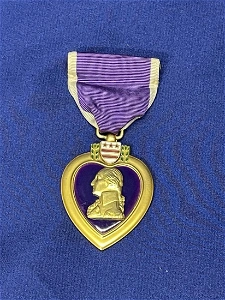
As I have gotten older, I am realizing more and more that my own grandparents did not live much past my current age. I find myself wondering what their life was like at this same stage in my life. I also find myself wishing that I had asked them more questions about their lives.
My father died at the age of 58 as did his father. My maternal grandmother died in her early 80’s, but my other two grandparents died in their early seventies, an age I am rapidly approaching.
My grandparents all lived through two World Wars and the Great Depression. As I was still a teenager when two of them died and a young married person when my maternal grandmother died, I did not think to ask them much about their lives. Now, I wish I had been more inquisitive and willing to listen to them.
As a teenager, I was an avid fan of military history from the Napoleonic Wars through WWII. I assembled and painted numerous plastic models of airplanes, warships, and tanks of WWI and WWII. I even painted some 2000 miniature plastic figures from the Napoleonic Wars, each one with an authentic uniform. I perhaps was one of the few youth who ordered books in French, with pictures of Napoleonic Uniforms and I had accounts with English booksellers for the same purposes. I had quite a collection of military figures, but when I returned home from college one year, I found that my parents had cleared out my bedroom to make it a more generic guest room and they threw them all out along with my models.
Bob, my mother’s brother, a private in the 29th Infantry Division of the United States Army, landed on Omaha Beach as part of the D Day Landings. He was separated for weeks from his unit, but eventually regrouped. Shortly after reuniting with his unit, he was wounded in the Battle of Saint-Lô, sometime between July 7 and 19, 1944. He was hit in the back of his right arm, most likely by shrapnel from explosives mistakenly dropped by American planes from behind the front lines. As an enthusiast of books and movies on WWII, I begged my uncle to tell me more about what he experienced overseas in combat, but my family always steered me away from that discussion with him. If I asked him alone, I got little out of him. The only story I ever heard from him was that as they approached the shore the landing craft that held him and his fellow combatants hit a German mine. Most of the soldiers drowned with 50 pound packs still on their backs, but my uncle, an excellent swimmer, was able to drop his pack and swim to shore, In the confusion, it took him three weeks to be reunited with his unit. He never really recovered from his ordeal, living most of the remainder of his life with his parents before dying at the age of 67 at the Soldier’s Home in Chelsea, Massachusetts. I remember that he had an abiding dislike of the nasal sound of the French language. That is what he remembered hearing, but not understanding, after he was wounded and transferred from hospital to hospital in the vain attempt to restore his damaged arm. Apart from that I know little else about his wartime experience.
Over the years, my uncle became more and more of a recluse, although to the family, he talked endlessly about cars and every new model that appeared. When he returned from the war, he felt that, because of his disability, he no longer was good enough for his girlfriend, and that he would only be holding her back from a happy life. Without telling her anything directly, his apparent disinterest in her drove her away gradually. That’s all I know. I realize now that he was most likely suffering from depression and some sort of PTSD, which was not understood well at the time. The term “shell shocked,” which emerged from the experience of troops from WWI, came the closest to describing his experience. His parents were endlessly frustrated by what they thought was my uncle’s lack of motivation and chalked it up to laziness. As a result, relations between my uncle and my grandfather were fraught. I was aware of this at the time, in the way a child knows that something is not quite right, but I loved to be with my uncle and looked up to him in a way that even now I can’t say exactly why.
After the war, Bob found it difficult to find a job. Before the war he had studied business, but the fact that, with his wounded right arm he was not able to shake hands, meant that few wanted to hire him. He ended up packing and shipping boxes in a factory that produced box toes for the shoe industry in Haverhill, Massachusetts.
Uncle Bob was my only uncle. My father was an only child and my mother only had one brother. o because Bob never married and had children, I never had an aunt or any first cousins. He was it. I wrote what I did here, so that my uncle’s story, however incomplete, is not entirely lost forever.
What remains of a person after they have died? I have none of my uncle’s personal effects. For a time we had his bed frame, but that is no longer with us. My mother framed his purple heart and other medals from the war and hung them on her wall. So what remains, other than the memories of those who, like me, knew him and still remember him? There are fewer and fewer people alive who knew Bob and knew some of his story. After all, he, like my father, was born about 100 years ago. What will happen when we too die and those memories are lost forever?
I began thinking about some of the events in my own life that I think were important and how I would like my children and grandchildren to know about them when I am no longer alive. I think it is time to start writing some of that down, because they, like me at their age, will not think to ask what later in their lives they might wish to know. My hope is that my memories will mix with their memories of me and perhaps that bundle will enrich their lives as well.
What would you want subsequent generations to remember most about you?
 IN THESE TIMES