
The Boston non-profit, A Faith that Does Justice, has published another submission of mine. This meditation examines Jesus as the “Beloved Son” of God who as such faces a difficult life as did Isaac and Jacob who were also “beloved sons.” It connects this account with the Baptismal Covenant of the Episcopal Church in which a promise is made “to respect the dignity of every human being.” Please read more!
“COSTLY GRACE”
Today the non-profit. A Faith that Does Justice, published my newest contribution urging Christians (and my secular audience as well) “to speak up and act whenever we see racism and intolerance in the world around us, that is, whenever we see an affront to the dignity of any human person.”
I speak as a retired Episcopal priest and as a Professor of Religion, who has published numerous articles on migration, refugees, and asylum seekers.
TO SOJOURN AND NOT TO DWELL
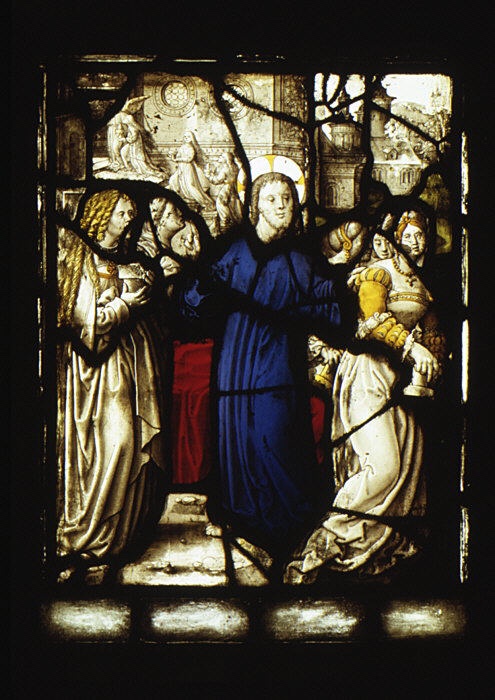
In Mt. 25: 1-13, we find Jesus’ parable of the wise and foolish bridesmaids which concerns their preparedness at the parousia, the return of the Jesus the bridegroom at his second coming: five were ready when the bridegroom returned at an unannounced time, but five were not. The five who were prepared with oil in their lamps could not share what they had because, readiness is not something you can share. It is something you have to cultivate within..
This story of the bridesmaids allows me to do something I rarely do in the pulpit and that is to connect what I have been writing on as an academic with what I preach. In the past ten years I have published numerous articles and chapters on the work of Giorgio Agamben. (You can find the bibliographic information on the page of this blog listing my academic publications.)
Giorgio Agamben is one of the most prominent continental philosophers alive today. He is a former student of Martin Heidegger, and even though he could be described as an atheist and somewhat of a philosophical anarchist, his work is based primarily on religious and theological texts, including a commentary on St. Paul’s Epistle to the Romans and a book on St. Francis and monastic rules. I became interested in him because he was the Italian editor of the writings of Walter Benjamin on whom I wrote one half of my doctoral dissertation and because of his use of theological texts in his non-religious philosophy. Agamben, I might add, is not easy to read or to understand.
In March 2009, Agamben was invited to Notre Dame Cathedral in Paris to give a lecture on his critique from his own philosophical perspective on the Roman Catholic Church. This address was subsequently published as The Church and the Kingdom. [1]
The earliest Christians, as is evident in the parable of the wise and the foolish bridesmaids in the Gospel of Matthew and in St. Paul’s first letter to the Thessalonians expected that the crucified and resurrected Jesus might return at any moment. St. Paul told Christians in his early writings that they should make no drastic changes to their life because Jesus was going to return any moment. If they were not married, for example, they should hold off marrying because the Lord might return at any moment. The present form of the world, he said more or less, is passing away, so don’t get too attached to it. (1 Cor. 7:31).
In his address in Paris, Agamben observed that “the Christian church has ceased…to sojourn as a foreigner,” and begun to dwell in the world and “live as a citizen in the world and thus function like any other worldly institution.” As the years went on and Christ did not return, the church began to settle in the world and put down roots. It ceased to sojourn and began to dwell. This for Agamben is the root of his critique of the church. [2]
The difference between sojourning and dwelling is something like the difference between being nomadic and settling down and building permanent dwellings. When you begin to dwell you get tied down to your own possessions and lose the ability to move quickly when needed, or adapt to changes.
St. Paul proclaimed freedom from the law. He urged Christians to live in the Holy Spirit in joyous freedom from the law. When the church began to dwell in the world, it became like other worldly institutions and set up legal structures that effectively replaced the law from which they, in Christ, had been freed. Agamben investigates St. Francis and other monastic rules, which in Latin are called regula (from which we derive our English word regular) to see if he could provide an alternative today for law (Latin, lex), investigating how one might free oneself from servitude to law in all of its contemporary manifestations.
To address this, Agamben does something quite interesting. He turns to St. Francis of Assisi and the first Franciscans. Francis wanted to live his life according to one rule only, namely that he live as Jesus Christ lived. He, therefore, renounced all his possessions so that he would be free from them and thus able to respond to Jesus in every area of his life. Francis became a kind of nomad. He gave up the idolatry of his possessions and found freedom. In his poverty he found exhilaration and joy. In subsequent centuries after Francis, Franciscans tried to figure out how, if they were going to live a life of perfect poverty, they could “use” things without owning them. Agamben turns to these texts and discussions to glean what he can for his own philosophical and political work.[3]
Returning to the story of the bridesmaids, five of them were ready but five were not. Why were the other five not ready? The story doesn’t tell us. Without reading too much into the parable we could surmise that they had been busy. They put off getting oil because they had other things to do, which at the time seemed more important.
Could it be that they had ceased to sojourn, and begun to dwell? They had become so attached to the things of this world and to the care of them, that they were not ready and prepared when the bridegroom (who in this story is clearly the person of Jesus Christ) returned. They had been claimed by what they owned and not by the person who owned them, Jesus Christ. This idolatry of things and possessions prevented them from the freedom to follow Jesus wherever he led.
The parable of the wise and foolish bridesmaids ends with these words, “Keep awake therefore, for you know neither the day nor the hour.” We know neither the day nor the hour of the Lord’s return. So, prepare yourselves. Begin by examining the things that hold you back—that tie you down—that enslave you— that keep you from responding to Jesus and his call to you. Can you begin to use things without owning them? Can you begin let go of the things that hold you back that keep you tied down? You can only be prepared for yourself. You cannot be prepared for someone else. “Keep awake therefore, for you know neither the day nor the hour when the bridegroom will return.” The question for you is, “when he does return, will you be ready?”
[1]Agamben, Giorgio, Leland De la Durantaye, and Alice Attie. The Church and the Kingdom. (London ; New York: Seagull Books, 2012).
[2] “…The Christian church has ceased to paroikein, to sojourn as a foreigner, so as to begin to katoiken, to live as a citizen and thus function like any other worldly institution. See Agamben, The Church and the Kingdom, p. 4.
[3] Agamben, The Highest Poverty. Monastic Rules and Form-of-Life. (Stanford, California: Stanford UP, 2013.
CRITIQUE AND EDIFICATION

The gifts he gave were that some would be apostles, some prophets, some evangelists, some pastors and teachers, to equip the saints for the work of ministry, for building up the body of Christ, until all of us come to the unity of the faith and of the knowledge of the Son of God, to maturity, to the measure of the full stature of Christ (Ephesians 4: 11-13).
St. Paul describes the church as the body of Christ in which those within it are given gifts to use to build up that body so that every person is brought to Christian maturity.
May 1, 2022, marks the 41st anniversary of my ordination to the priesthood. When I graduated from seminary in 1979, I felt called to ordained pastoral ministry and to a ministry of teaching. I have not always found it easy to combine these mutual vocations. After graduation, I spent one year in clinical training as a hospital chaplain. Following that, I was placed in charge of two congregations in rural Oklahoma as a lay vicar. Five months later, and four days after our first child was born, I was ordained to the diaconate. During this time, I wrestled with the idea of a vocation that combined both ministry and teaching. Six years later, after working in St. Louis for a couple of years, I decided to go back to graduate school to pursue a doctorate in theology and ethics at Duke University. Within a few months of my arrival in Durham, North Carolina, I began to serve as regular supply priest in rural congregations. Soon I was serving in part-time interim ministry, sometimes in more than one congregation at a time. My working life was divided between teaching at Duke and UNC-Chapel Hill and work in interim parish ministry. I mention this because these experiences provided me with a perspective from which to see the church in a different light.
The purpose of the church at its best is to build us up so that we become knitted together in the body of Christ. Its purpose, therefore, is to edify us, that is, to build us up, both personally and communally. Moving between these two environments in my career provided me with the insights I would like to share with you here.
The purpose of the university at its best is to critique every idea or procedure and from that process to arrive at new understandings in every area of our lives, from the medicine we need to heal our bodies, to an understanding of our universe in all its complexity, to questions concerning the meaning of our lives.
In the academic world a distinction is made between “criticism” and “critique.” Criticism points to minor errors and inconsistencies in the work under examination. Critique, on the other hand, seeks to find if and how the entire work under examination is inconsistent with its own principles, and whether as a result the work or project is flawed from the start. In graduate school, students are taught how to tear academic positions on any topic to shreds. They are taught, in other words, to critique everything they read or hear. Graduate education teaches students to categorize thought and quickly make suggestions as to the error, faults, and even the impossibility, or utter contradiction in the work under examination.
I remember a particular graduate seminar I taught at Temple University in which we examined the work of the French sociologist and philosopher Pierre Bourdieu. I was trying to make a point using an idea suggested by Bourdieu. My students rushed in to condemn the way in which Bourdieu constructed his argument. I tried to defend the usefulness of his position despite its inherent weaknesses, but my students would not hear of it. When I reflected later in the day on the feeling and emotion behind their arguments, I realized that they were only doing what they were being taught to do. They were demonstrating to me that they could engage in a vigorous philosophical critique of their assigned readings.
This emphasis on critique is why university professors and other academics are often charged with being nihilists. If every position is equally flawed, then how can one ever endorse any position or idea? How then does one live her or his life? That is one of the dilemmas one faces in the university environment.
The life of the university thrives on critique, that is, on the process of challenging dominant assumptions and formulating in their place different and oftentimes unpopular ways of looking at things. This is an important task and I by no means want to belittle it. New ideas and approaches to more ancient problems, more often than not, are enriching and enlivening.
In contrast to the university, the central task of the church is neither critique nor criticism, although that is how life within it often feels for lay and clergy alike. At its worst the church is a critical and unsupportive place. Because we all are imperfect people, it is not surprising that we often see the fault in others, before we see that same fault in ourselves. Jesus recognized this when he asked his hearers, “why do you see the speck in your neighbor’s eye, but do not notice the log in your own eye?”
At its best, the task of the church is not to tear us down but to edify and to build us up. If we want the church to become a supportive place, we must pay attention to the ways in which we respond positively to the needs and desires of others. If we ourselves want to be supported, we first must learn to become supportive of others. Together, and only together, can we grow “to the measure of the full stature of Christ.”
“THE LORD LIKES BLUE CHEESE”

Many people are committed to working for God in the church. As they go about the tasks at hand, they hope that they are doing what they call “God’s will.” In my experience, persons on Vestries and other committees of the church facing difficult decisions don’t often stop their meetings to ask aloud what “God’s will” might be for their church in the decision at hand. And so, they figure that if they just proceed as they normally would, God will bless all their endeavors done in God’s name with success.
If you find yourself having to make decisions like this, I would like you to ask yourself this question: are you doing “works for God” or are you doing “God’s work”? There is a difference. Works done for God may be performed merely out of self-interest. Doing God’s work means that you have taken the time to discern with your sisters and brothers in Christ exactly what “God’s work” might be at a particular time and in a particular situation.
Thomas Green, a Roman Catholic priest who served in the Philippines, illustrates the difference between God’s work and works done for God. He develops his ideas in two inter-connected books, When the Well Runs Dry and Darkness in the Marketplace.1 Citing the story of Mary and Martha in the gospel of Luke, Green observes that Martha was busy doing works for Jesus while Mary was sitting at the Lord’s feet “listening to his teaching (Luke 10:38-42). While both of their labors were important, Martha, as Jesus reminded her, needed to stop her busy-ness and listen to the words of her Lord: “Martha, Martha, you are anxious and troubled about many things; one thing is needful.”
Fr. Green remembers how, when friends travelled back to the United States for visits, they would often ask him if he would like them to bring anything back for him. He told them he would love some blue cheese, an item not easily found in the Philippines. Many of his friends who themselves did not like blue cheese would return with something “better” in place of the cheese he had requested. Fr. Green observes that he knew he had a true friend, that is, one who truly cared about him, when the friend who personally hated blue cheese nonetheless brought some back as a gift. Fr. Green concludes that God is like that. God often asks us for blue cheese but we feel the need to do something “better.” When we try to do something “better”, are we busy doing works for God or are we doing God’s work? Are we so “anxious and troubled about many things” that we do whatever we want, or are we doing what “is needful?, that is, what God may be asking us to do.
As you think about what God wants from us, take time to reflect on the difference between “God’s work” and “works for God.” Remember: “the Lord likes blue cheese!”
1Thomas H Green, S.J., When the Well Runs Dry: Prayer Beyond the Beginnings (Notre Dame, IN: Ave Maria Press, 1979); Darkness in the Marketplace: The Christian at Prayer in the World (Notre Dame, IN: Ave Maria Press, 1981).
THREE RECENT PUBLICATIONS OF MINE
-

-
 Images copyright of Palgrave MacMillan / Springer Nature
Three chapters of mine have recently been published in separate volumes of the Palgrave Macmillan series, “Pathways for Ecumenical and Interreligious Dialogue.” The books in this series derive to a great extent from expanded conference presentations at meetings of the Ecclesiological Investigations International Research Network. Two of the three chapters published recently arose from conference presentations, and one was written especially in memory of a departed colleague, Gerard Mannion of Georgetown University. To date, I have published chapters in five separate books in this series, with one still forthcoming. (The details of the publications can be found on the “Academic Publications” page of this blog and in the links at the end of paragraphs below.)
I don’t often write about my academic publications in this blogspace, but because these publications allow me to address both the academy and the church at the same time, they may be of interest to some of my readers.
All three of these chapters employ the work of the Italian philosopher and political theorist, Giorgio Agamben, to engage specific theological topics and issues. While Agamben writes from outside the church, his writings often illuminate ideas and themes from the Christian archive, that might otherwise go unnoticed by those working from within a Christian perspective. In using resources from Agamben for my own purposes, and not necessarily in the way that he deploys them, I aim to craft new perspectives on Christian theological themes and issues.
The title of the chapter in Changing the Church, “To Live according to the Form of the Holy Gospel: St. Francis of Assisi’s Embodied Challenge to the Institutional Church,” is taken from the words St. Francis of Assisi used to describe his manner and form of life, that is, he sought solely to live according to the form of life described in the Holy Gospels (forma sancti Evangelii). The chapter explores what the contemporary church can learn from Francis of Assisi and the monastic traditions of the church so that by focusing less on itself as an institution, the church might offer concrete resources to help contemporary Christians find continuity between who they are and what they do. The second half of the chapter examines “The Way of Love,” promulgated by the Presiding Bishop of the Episcopal Church, Michael Curry, understood as practical ways of living out the gospel in the modern world. This contribution was part of a volume in memory of Georgetown Professor Gerard Mannion, a founder of the Ecclesiological Investigations International Research Network, who died unexpectedly, in 2019. https://doi.org/10.1007/978-3-030-53425-7_29
My chapter in The Church and Migration: Global (In)Difference entitled, “The Refugee as Limit-Concept of the Modern Nation State,” contrasts the work of two of the most influential contemporary international voices on behalf of refugees, migrants, and asylum seekers, Giorgio Agamben and Pope Francis. After an explanation of the the way that Agamben understands the refugee to be the “limit concept of the modern nation state,” I examine a few of Pope Francis’ statements and comments on the status of migrants and refugees in light of Agamben’s analysis of the refugee crisis and its integral connection to the nation-state. https://doi.org/10.1007/978-3-030-54226-9_11
Finally, my chapter in Stolen Churches, or Bridges to Orthodoxy, Volume 2 was first presented at a 2019 conference in Stuttgart as part of an ongoing dialogue between Eastern Catholic and Eastern Orthodox Christians. The chapter entitled, “Giorgio Agamben’s Stasis (Civil War): An Illuminating Paradigm for Ecumenical Dialogue?” examines how Agamben’s paradigm of stasis (civil war) might shed light on contemporary conflicts and engagements between Eastern Catholic and Eastern Orthodox Churches. https://doi.org/10.1007/978-3-030-55458-3_3
I will make a similar announcement, when another chapter of mine is published in Ecumenical Perspectives Five Centuries after Luther’s Reformation later this year.
THE VIRTUE OF SELF-CONTROL

Photo by Caleb Gregory on Unsplash
Over the past few months, I have reflected on what St. Paul in his letter to the Galatians calls “the fruit of the Spirit.” This fruit refers to the virtues evident in the lives of those who have truly patterned themselves on the example of Jesus Christ. The reason that the New Testament writers focus on the virtues, is so that Christians can live and work joyfully and productively in community.
We find a similar list of virtues in 2 Peter presented as a plan for those who seek to make progress in the Christian life.
[Y]ou must make every effort to support your faith with goodness, and goodness with knowledge, and knowledge with self-control, and self-control with endurance, and endurance with godliness, and godliness with mutual affection, and mutual affection with love. For if these things are yours and are increasing among you, they keep you from being ineffective and unfruitful in the knowledge of our Lord Jesus Christ” (2 Pet 1:5–8 NRSV).
To help understand the flow of the argument in 2 Peter, it is helpful to arrange the words in a different, more structured, way.
You must make every effort to support your:
Faith with goodness (lit. virtue)
Goodness with knowledge
Knowledge with self-control
Self-control with endurance
Endurance with godliness
Godliness with mutual affection (Gk. Philadelphian, lit. “brotherly love”)
Mutual affection with love
Love….
In the classical Greek thought of Aristotle, the word “virtue” refers literally to an “excellence,” a behavior, that we develop over time. We gain virtue from practice. Virtue, in other words, is gained much like a skill. We learn as we fail and as we succeed, always building and growing. We don’t gain virtue all at once but rather we develop it over time.
In 2 Peter we find the outlines of a program for the formation of Christian virtue; it begins with faith and ends with love, the pinnacle of Christian virtue (“And now faith, hope, and love abide, these three; and the greatest of these is love. 1Cor. 13:13). The purpose of the program is so that we may not be “ineffective” or “unfruitful.” In more positive terms, the program is presented so that our lives in Christ might bear fruit, genuine fruit.
When we compare the list of virtues that St. Paul identifies in Galatians 5:22-23 (love, joy, peace, patience, kindness, generosity, faithfulness, gentleness, and self-control) with the list in 2 Peter, we find some similarities and differences. “Patience” and “endurance” have similar, but not exact, meanings as do “gentleness” and “mutual affection” (lit. “brotherly love.”). [The virtue of endurance refers to the ability to hold up under difficult circumstances. For that reason, I wrote about that virtue previously relating it to the “resilience” we need to bounce back from upsets, disappointments, and failures.]
The only two words, however, that are precisely the same in both Galatians and 2 Peter are “self-control” and “love.”
I would like to focus further attention on the virtue of “self-control.” “The virtue of self-control” “involves the restraint of one’s emotions, impulses, and desires.” *
The New Testament writers were familiar with Greco-Roman philosophical ideas about moral virtue of self-control. The idea was common to the Greek philosophies of Epicurus and Zeno, the father of Stoicism. It is also found in the “wisdom literature” of the Old Testament. In Proverbs 25:28, for example, we read: “Like a city breached, without walls, is one who lacks self-control.”
A staple of Hellenistic moralism, we find self-control central to the argument of 4 Maccabees, a book not found in our Bible, but one that is canonical in some Eastern Orthodox Churches.
[I]t is evident that reason rules over those emotions that hinder self-control, namely, gluttony and lust, it is also clear that it masters the emotions that hinder one from justice, such as malice, and those that stand in the way of courage, namely anger, fear, and pain (4 Mac. 1:4).
Modern psychological study and research now recognize that reason does not always go hand in hand with self-control, especially when it comes to addiction. People facing addiction realize all too readily that they have no power within themselves to control themselves. That is why the beginning of treatment starts with the recognition of the powerlessness of the human will in the face of addiction.
To live and work with others productively in community, we have to exercise some measure of self-control. We should always think before we speak. In James 1:19 we find just such an admonition: “You must understand this, my beloved: let everyone be quick to listen, slow to speak, slow to anger….” Notice it does not say quick to speak and slow to listen, but “quick to listen and slow to speak.” Here a practical example is given to help us understand what it means to exercise self-control in our dealings with others.
The New Testament is full of advice on how to live together in community. While there is much more I could say about this, the words of St. Paul sum it up best when he says that we should “love one another with mutual affection; outdo one another in showing honor.” Striving to do that first and foremost lays the foundation for the “self-control” of our impulses and emotions.
*Michael J. Harrington, S.J, Jude and 2 Peter, Sacra Pagina Series. (Collegeville, MN: The Liturgical Press, 2003), p. 244-5.
 IN THESE TIMES